
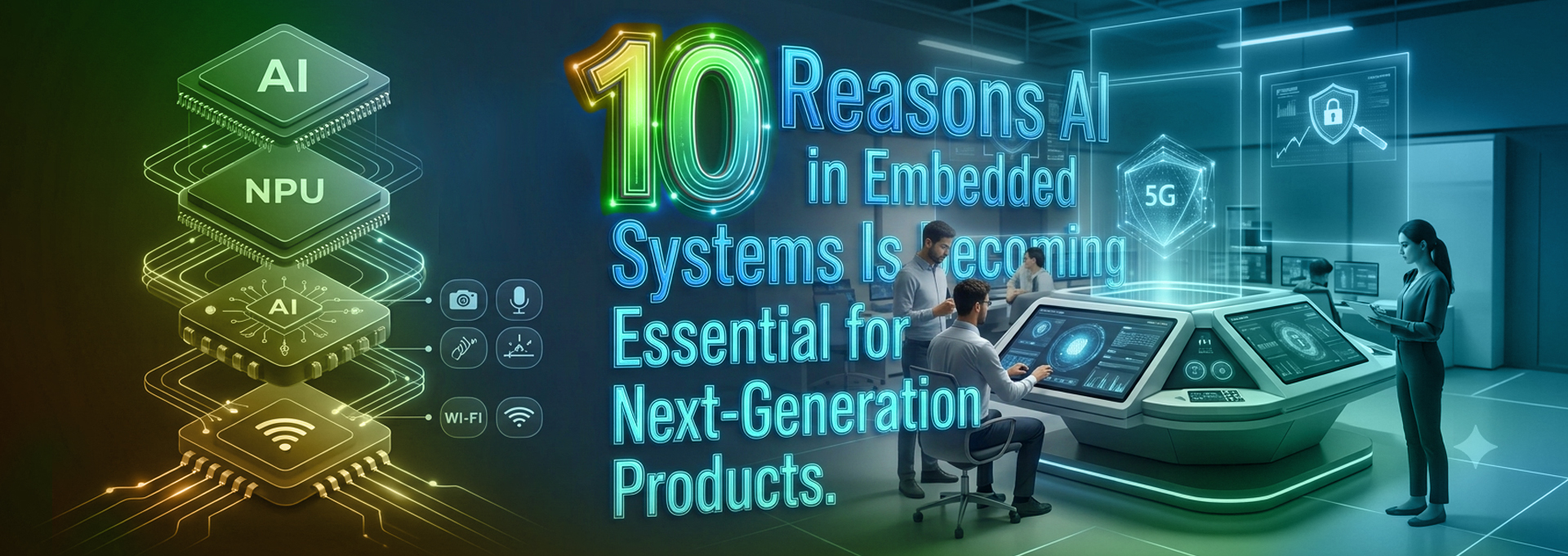
For OEMs, product engineers and technology businesses, embedded systems are moving beyond fixed-function computing. Modern products are expected to interpret sensor data, identify anomalies, make decisions locally and respond in real time. This is driving the rapid adoption of AI in Embedded Systems, particularly across fintech, industrial automation, healthcare, automotive, robotics and IoT.
The market signals are strong. Fortune Business Insights estimates that the global embedded AI market will reach $13.49 billion in 2026, growing to $48.90 billion by 2034 at a 17.5% CAGR. Gartner, meanwhile, forecasts global AI spending at $2.59 trillion in 2026, a 47% increase year over year.
AI and Embedded Systems: The Numbers Behind the Shift
| Indicator | Latest figure | What it indicates |
| Global Embedded AI market, 2026 | $13.49 billion | Rapid commercialisation of embedded intelligence |
| Embedded AI market, 2034 | $48.90 billion | 17.5% projected CAGR |
| Global AI spending, 2026 | $2.59 trillion | 47% YoY growth in AI investment |
| Edge AI market, 2026 | $46.96 billion | 32.5% projected CAGR through 2034 |
| IoT connections, Q1 2025 | 17.1 billion+ | Expanding intelligent-device ecosystem |
10 Reasons AI in Embedded Systems Is Becoming Essential
1. Real-Time Decision-Making
Cloud-based AI depends on network connectivity and round-trip processing. Embedded AI enables inference directly on MCUs, MPUs, SoCs and NPUs, allowing products to respond almost immediately to sensor inputs.
A 2025 Sensors survey reported that TinyML implementations have demonstrated latency reductions of up to 44.5× compared with traditional cloud-based approaches in specific applications.
2. Lower Latency for Critical Applications
For industrial controllers, biometric terminals, robotics and automotive systems, latency directly affects operational performance. Local inference removes unnecessary network delays and supports deterministic responses for computer vision, anomaly detection and predictive control.
The shift was highly visible at Embedded World 2026, where NXP showcased AI-powered edge devices and dedicated sessions on applying AI/ML to processors and real-world embedded applications in March 2026.
3. Reduced Dependence on Cloud Infrastructure
An intelligent device can analyse data locally and transmit only relevant information. This reduces bandwidth requirements and can lower recurring cloud-processing costs, particularly across large IoT deployments.
4. Improved Data Privacy and Security
Local inference can keep sensitive biometric, financial and operational data closer to its source. For sectors such as BFSI, healthcare and e-governance, this supports stronger data-minimisation strategies while reducing unnecessary data transmission.
5. Predictive Maintenance
AI can identify patterns across vibration, temperature, acoustic and electrical signals before conventional threshold-based systems detect a failure. This makes predictive maintenance a practical embedded-AI application for factories, machinery and connected infrastructure.
6. Smarter Computer Vision and Sensor Fusion
Next-generation products increasingly combine cameras, fingerprint sensors, microphones, accelerometers, and other inputs. AI allows embedded platforms to fuse these signals and interpret context rather than simply collect measurements.
Research published in 2026 demonstrated the potential of TinyML for resource-constrained environments: optimized models achieved an average 89.55% reduction in RAM usage and 70.09% reduction in Flash memory, while maintaining task-acceptable accuracy.
7. Greater Energy Efficiency
Embedded AI must operate within strict power and memory budgets. Consequently, quantization, pruning, knowledge distillation and hardware acceleration are becoming essential engineering techniques.
A May 2025 TinyML study benchmarked models 1,000 times across configurations to evaluate energy and latency, demonstrating why hardware-software co-optimization matters when deploying AI on resource-constrained MCUs.
8. More Autonomous Products
AI transforms embedded products from rule-based systems into adaptive platforms. Robotics, smart mobility, industrial equipment, and connected devices can increasingly recognize conditions and adjust their behaviour without constant human intervention.
A 2025 review analyzing 779 Scopus-indexed publications identified edge computing, deep learning, IoT integration, microcontroller efficiency, and energy utilization among the major themes shaping TinyML research.
9. Faster Product Differentiation
AI can turn conventional hardware into intelligent products through software-driven capabilities such as fraud detection, biometric authentication, predictive diagnostics, voice recognition and adaptive control. This creates opportunities to differentiate products without continuously changing their physical architecture.
10. AI Is Becoming Part of the Semiconductor Roadmap
The embedded hardware industry is responding accordingly. In Q2 2026, AMD’s embedded segment generated $977 million in revenue, representing 19% year-over-year growth, with demand across networking, aerospace, defence and other embedded applications.
AI in Embedded Systems: What It Means for Evolute Group
For Evolute Group, the convergence of embedded electronics, AI, biometrics and connected devices aligns closely with its product innovation strategy. Evolute’s L1-certified ecosystem includes AI-enabled biometric technologies designed for applications such as digital onboarding, BFSI, e-governance and secure transactions.
Its eScan L1 incorporates a FAP20 fingerprint sensor with Active Thermal Sensing and Adaptive AI for live/fake fingerprint detection. Its Leopro 5G Hyper Terminal combines AI-enabled fraud detection and smart analytics with multimodal biometric authentication and 5G connectivity.
This demonstrates an important industry transition: intelligence is increasingly being designed into the device architecture, rather than added as a cloud-based feature after deployment.
The Business Case for Intelligent Embedded Products
For technology companies, the strategic value of embedded AI extends beyond adding an AI model. Successful implementation requires coordinated decisions across hardware acceleration, firmware, operating systems, model optimisation, cybersecurity, connectivity and lifecycle management.
| Business requirement | Embedded AI advantage |
| Response time | Local, low-latency inference |
| Connectivity | Reduced cloud dependency |
| Security | Local processing of sensitive data |
| Energy | Optimised TinyML and NPU execution |
| Product intelligence | Adaptive and predictive functionality |
| Differentiation | AI-powered features at device level |
Conclusion: Intelligence Is Moving Closer to the Device
The next generation of products will not simply be connected they will be context-aware, predictive and increasingly autonomous. The rapid growth projections for embedded AI, expanding edge-AI investment and advances in TinyML hardware show that this transition is already underway.
Key takeaways:
- AI in Embedded Systems enables faster, real-time decision-making.
- Edge inference can improve privacy while reducing cloud dependency.
- TinyML is making AI practical on constrained devices.
- AI-powered sensor fusion is expanding product capabilities.
- Hardware-software co-design is becoming critical for efficient deployment.
- For OEMs and technology businesses, embedded intelligence is increasingly a product strategy, not merely a technology feature.