
Imagine you are making a payment at a retail store. You tap your card, the transaction is approved within seconds, and you receive your receipt. From your perspective, it feels simple.
But what happens behind that simple experience?
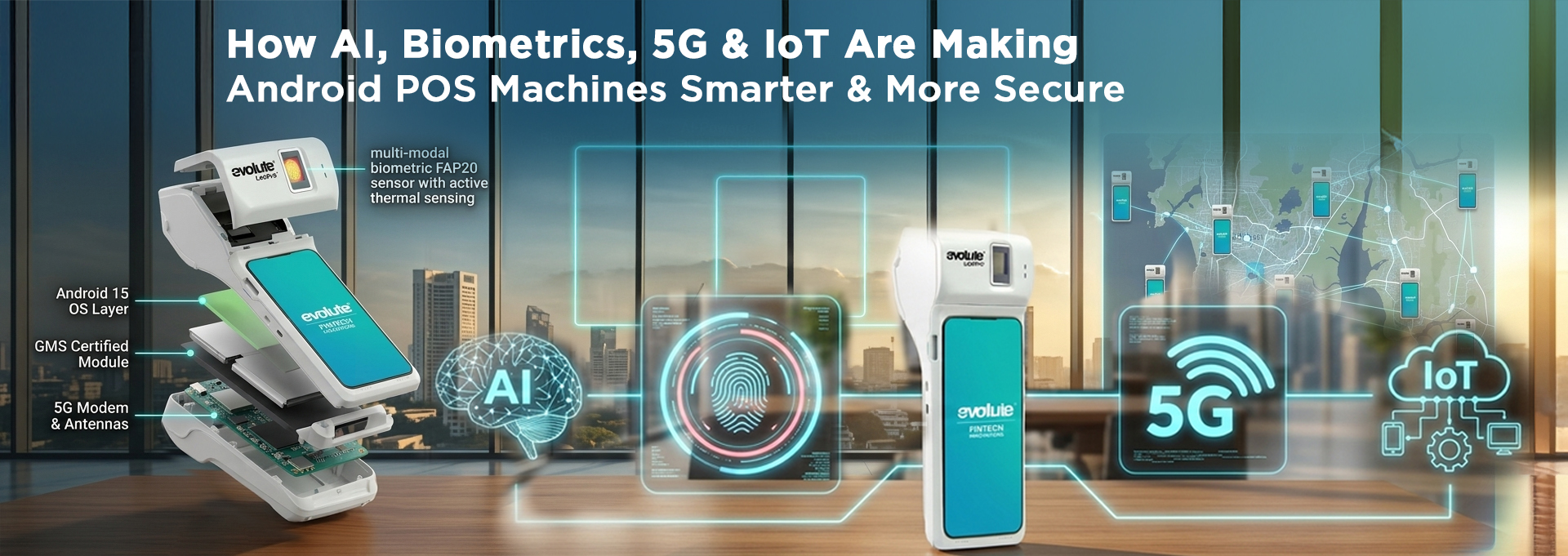
Modern payment terminals are processing data, communicating with payment networks, authenticating transactions and increasingly using technologies such as Artificial Intelligence (AI), biometrics, 5G and the Internet of Things (IoT).
This is how the Android POS Machine is evolving. It is no longer just a device for accepting payments. It is becoming a connected fintech platform designed to make transactions faster, smarter, more secure and easier to manage.
And there is another important part of this transformation: user experience. The best payment technology is not simply the technology with the most features. It is the technology that makes the customer’s and merchant’s experience feel effortless.
2026 Digital Payments and Technology Snapshot
India’s payment ecosystem provides a useful picture of why smarter POS infrastructure is becoming important.
| Metric | Latest available data |
| UPI transactions – August 2026 | 24.51 billion |
| UPI transaction value – August 2026 | ₹29.82 lakh crore |
| Banks live on UPI – August 2026 | 752 |
| Aadhaar authentication – FY2025–26 | 17,759.21 crore |
| Aadhaar eKYC transactions – FY2025–26 | 2,457.95 crore |
| Global 5G subscriptions – 2026 | Close to 3.3 billion |
| Global mobile data traffic growth | 23% from Q2 2025 to Q2 2026 |
| Financial-services firms planning to increase AI investment | 94% |
Sources: NPCI, UIDAI, Ericsson and Deloitte, 2026.
These figures matter because higher digital-payment volumes require payment infrastructure that can handle connectivity, identity, security, processing and device management without making the experience complicated for the user.
What Is an Android POS Machine?
An Android POS Machine is a payment terminal built on the Android operating system that can combine payment acceptance with applications, connectivity, authentication and business services.
Think about the difference between an old-style payment terminal and a modern smartphone. A traditional terminal may be designed mainly around a transaction. An Android POS terminal can behave more like a compact computing platform.
It can support:
- Card and contactless payments
- Digital payment applications
- Biometric authentication
- eKYC services
- Cameras and scanning
- Wireless connectivity
- Remote software updates
- Business applications
- Device management
For the user, this can mean fewer devices, fewer steps and a smoother interaction.
How AI Is Making Android POS Machines Smarter
You may not always see AI working inside a POS terminal, but you can experience its impact.
AI-powered fraud and risk detection
AI can analyse transaction and device-level patterns to identify unusual behaviour and potential risk indicators.
For example, if a transaction pattern suddenly differs from normal activity, intelligent systems can help flag it for further analysis.
This becomes increasingly relevant as financial institutions expand their AI investments. Deloitte’s January 2026 research found that 94% of financial-services firms planned to increase AI investment over the following 12 months.
AI can also improve the user experience
AI is not only about fraud detection.
It can support:
- Smarter transaction analytics
- Device diagnostics
- Predictive maintenance
- Personalised business insights
- Faster identification of operational problems
For a merchant, this could mean fewer unexpected device issues. For a customer, it can mean a payment experience that is less likely to be interrupted by avoidable technical problems.
How Biometrics Is Making Android POS Machines More Secure
Now imagine a banking or eKYC transaction where simply entering information is not enough. The system needs to establish that the person presenting the identity actually matches the registered identity.
This is where biometric authentication becomes valuable.
Fingerprint, iris and facial recognition can provide an additional layer of identity verification for applications such as:
- Aadhaar-enabled services
- eKYC
- Banking
- Financial inclusion
- Agent-assisted services
- Government services
- Secure merchant authentication
The scale of Aadhaar usage demonstrates how significant biometric identity infrastructure has become. UIDAI reported 17,759.21 crore Aadhaar authentication transactions during FY2025–26, while Aadhaar eKYC transactions reached 2,457.95 crore.
What does this mean for the user?
Good biometric UX should make security feel easier—not harder.
Instead of remembering another password or entering lengthy information, a user may be able to authenticate through a biometric interaction that takes only a few seconds.
Evolute’s eScan L1, for example, uses an L1-certified FAP20 fingerprint sensor with active thermal sensing and adaptive AI designed for fake-fingerprint detection.
The goal is simple: stronger authentication without unnecessarily complicating the user’s journey.
How 5G Is Transforming the Android POS Machine
Connectivity is another part of the POS experience that users notice immediately especially when it fails.
A payment terminal with unreliable connectivity can turn a five-second transaction into a frustrating wait.
The June 2026 Ericsson Mobility Report states that global 5G subscriptions were approaching 3.3 billion, while 5G carried around half of global mobile data traffic. Global mobile network data traffic increased 23% between Q2 2025 and Q2 2026.
For a 5G POS terminal, stronger connectivity can support:
- Faster communication with payment systems
- More reliable cloud connectivity
- Real-time application communication
- Connected financial services
- Remote device management
- Data-intensive applications
Evolute’s LeoPro takes this approach further with Android 15, GMS certification, 5G connectivity, multi-modal biometric authentication and AI-enabled fraud detection and smart analytics.
From a customer’s perspective, the technology is successful when they simply experience a quick, uninterrupted transaction.
How IoT Turns POS Machines Into Connected Devices
What happens when a business has hundreds or thousands of POS terminals deployed across different locations?
Manually checking every device becomes impractical.
This is where IoT-enabled POS infrastructure becomes important.
IoT allows devices to communicate with central systems for activities such as:
- Remote monitoring
- Device configuration
- Application management
- OTA software updates
- Device health monitoring
- Data synchronisation
- Troubleshooting
Evolute’s fintech ecosystem includes MQTT and TMS capabilities, supporting connected device management and OTA updates across its device portfolio.
For the end user, the benefit is often indirect—but important. Better device management can help businesses keep terminals operational, updated and ready for transactions.
How AI, Biometrics, 5G and IoT Work Together
The real advantage does not come from using these technologies separately. It comes from combining them.
Consider a field banking agent helping a customer complete an eKYC transaction:
5G provides connectivity → biometrics verifies identity → AI helps identify suspicious patterns → IoT/TMS keeps the terminal monitored and updated.
The user sees a simple interaction.
Behind that interaction, several technologies are working together.
That is the real evolution of the smart Android POS Machine.
User Experience Is Becoming a Core POS Feature
When evaluating a POS terminal, businesses often focus on specifications such as processor, RAM, connectivity, certifications and battery capacity.
Those specifications matter—but ask another question:
What will the user experience actually be like?
A modern POS experience should ideally provide:
| User Requirement | Technology Supporting It |
| Quick transactions | 4G/5G and efficient processing |
| Easy authentication | Biometrics |
| Secure payments | Payment security and encryption |
| Fewer interruptions | IoT monitoring and device management |
| Easy-to-use applications | Android platform |
| Faster issue detection | AI analytics |
| Remote updates | TMS/OTA infrastructure |
| Multi-service interaction | Android application ecosystem |
For merchants, better UX can mean faster customer queues and easier operations. For customers, it can mean less waiting, fewer unnecessary steps and greater confidence during payment or identity verification.
Evolute’s Android POS and Fintech Device Ecosystem
Evolute Fintech Innovations brings these technologies together across a wider fintech device portfolio.
Its ecosystem includes LeoPOS, UniPOS A5, Leopard and Leopard+, along with biometric devices, MicroATMs, thermal printers and other payment infrastructure.
LeoPOS, for example, combines Android-based computing with card, contactless and wireless connectivity. UniPOS A5 supports multiple biometric authentication methods and omni-channel payment applications.
Meanwhile, LeoPro represents Evolute’s newer generation of connected fintech hardware by bringing together 5G, Android 15, biometrics and AI-enabled capabilities.
This ecosystem approach allows POS technology to extend beyond traditional checkout into banking, eKYC, financial inclusion, government services and connected commerce.
What Makes a Smart Android POS Machine Secure?
Security should not depend on a single feature. A modern POS environment needs multiple layers working together.
| Security & Technology Layer | Purpose |
| Secure Android environment | Protects the device operating environment |
| Payment security | Protects payment transactions |
| Biometrics | Strengthens identity verification |
| AI | Supports intelligent risk analysis |
| 5G/4G/Wi-Fi | Provides connectivity |
| IoT/TMS | Enables remote management |
| OTA updates | Keeps software current |
| Encryption and access controls | Protects sensitive information |
This layered approach is important because modern POS security extends beyond the payment transaction itself. Device, identity, application, network and data security all need to work together.
What Will the Android POS Machine Look Like in the Future?
The future POS terminal is unlikely to be defined simply by how quickly it processes a card payment.
Instead, its value will increasingly come from how well it combines:
Payments + Identity + AI + Connectivity + IoT + User Experience
Imagine a terminal that can authenticate a customer securely, connect instantly to payment infrastructure, detect unusual activity, support multiple financial applications and receive updates remotely—all while keeping the interaction simple for the person using it.
That is the direction in which the Android POS Machine is moving.
Conclusion
The next generation of POS technology is being shaped by more than payment processing. AI, biometrics, 5G and IoT are turning Android POS Machines into intelligent, connected fintech platforms.
For businesses and financial institutions, the opportunity is to build payment environments that are not only secure, but also easier to operate and more convenient for customers.
The key developments to watch are:
- AI for smarter analytics, fraud detection and device intelligence
- Biometrics for stronger and more convenient identity verification
- 5G for faster and more reliable connectivity
- IoT for remote monitoring and large-scale device management
- Android for flexible applications and multifunctional terminals
- User experience for bringing all these technologies together in a simple customer journey
Ultimately, advanced payment technology succeeds when the complexity stays behind the screen while the user experiences something much simpler: a fast, secure and effortless transaction.

