
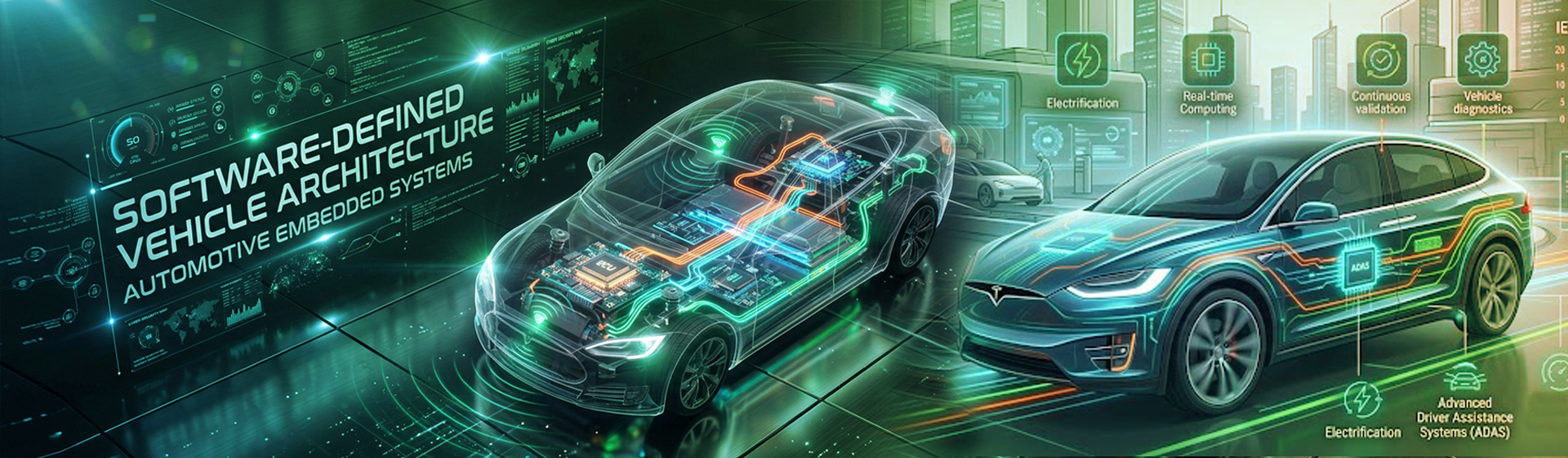
A modern vehicle is increasingly becoming a computing platform on wheels. Software now influences functions ranging from Advanced Driver Assistance Systems (ADAS) and battery management to infotainment, connectivity and vehicle diagnostics. This transformation is creating the Software-Defined Vehicle (SDV), where software increasingly determines how a vehicle functions, evolves and receives new capabilities.
The shift is closely linked to electrification. According to the International Energy Agency (IEA), global electric car sales exceeded 20 million in 2025, growing 20% year-on-year and representing around one-quarter of all new cars sold worldwide. The IEA expects electric car sales to reach around 23 million in 2026, accounting for approximately 29% of global car sales.
At the foundation of this transformation is embedded system development. Embedded processors, firmware, sensors, communication networks and control software provide the computing infrastructure required to make vehicles intelligent, connected and increasingly updateable.
Why Embedded System Development Matters for Software-Defined Vehicles
An automotive embedded system combines dedicated computing hardware, firmware, software, sensors and communication interfaces to perform specific functions in real time.
The basic process can be represented as:
Sensors → Embedded Processor → Software/Firmware → Decision → Vehicle Action
For example, in an automatic emergency braking system, cameras or radar detect an object, embedded processors analyse the incoming data, software determines the appropriate response, and the vehicle’s control system can initiate braking.
This makes embedded system development much more than firmware programming. Automotive development increasingly involves hardware-software co-design, real-time computing, connectivity, cybersecurity, and continuous software validation.
The Automotive Industry Is Moving Toward Software-Centric Architecture
The IEA’s 2026 analysis explains that conventional distributed electronic architectures are increasingly giving way to domain and zonal architectures, where fewer, more powerful computing units control multiple vehicle functions. This can reduce wiring complexity while allowing a larger share of vehicle functionality to be defined and updated through software.
| Industry indicator | Latest figure | What it means |
| Global EV sales in 2025 | 20+ million | Large-scale electrification is accelerating demand for automotive electronics |
| EV share of global new-car sales in 2025 | ~25% | Around one in four new cars sold was electric |
| Expected global EV sales in 2026 | ~23 million | EVs are becoming an increasingly important SDV platform |
| Expected EV share of global car sales in 2026 | ~29% | Software-enabled electric platforms are expanding rapidly |
| Global BEV share across 45 markets, H1 2026 | 17% | BEV penetration more than doubled from 6% in 2021 |
Source: IEA Global EV Outlook 2026; JATO SDV analysis, 2026.
The numbers demonstrate why embedded electronics are becoming strategically important: as the number of software-enabled and electric vehicles increases, the underlying computing and control infrastructure becomes more important to vehicle manufacturers and technology suppliers.
How Embedded System Development Enables the SDV Ecosystem
SDVs require embedded platforms capable of supporting increasingly sophisticated software stacks. These include automotive microcontrollers, high-performance processors, System-on-Chip (SoC) platforms, real-time operating systems, Automotive Ethernet, CAN networks, sensor interfaces and secure firmware.
The 2026 State of Automotive Software Development survey, based on more than 450 automotive development professionals, highlights how quickly the development landscape is changing.
| Automotive software development indicator | 2026 figure |
| Organisations actively working on SDV architectures | 57% |
| Organisations including EV architecture in their SDV strategy | 81% |
| Organisations integrating AI into vehicles | 71% |
| Organisations using AI for SDV system optimisation | 70% |
| Developers reporting software complexity as a major quality concern | 53% |
| Organisations using at least one coding standard | 82% |
Source: Perforce, 2026 State of Automotive Software Development.
These findings show that embedded system development is evolving into a multidisciplinary engineering process involving software architecture, AI, cybersecurity, testing, hardware integration, and safety.
For automotive technology providers, this means designing an embedded platform is no longer only about selecting a processor and writing firmware. The complete lifecycle—from hardware design to software deployment and updates needs to be considered.
Embedded Systems Power ADAS and Electric Vehicles
ADAS is one of the clearest examples of embedded intelligence in modern vehicles. Cameras, radar and other sensors continuously generate data that embedded computing platforms must process with low latency.
Applications include:
- Adaptive cruise control
- Lane-keeping assistance
- Automatic emergency braking
- Blind-spot monitoring
- Parking assistance
- Driver monitoring
The technology is becoming increasingly mainstream. According to the IEA, around half of new cars sold globally in 2025 featured systems capable of automating steering and speed control at Level 2, compared with less than 1% of sales a decade earlier.
EVs further increase the need for embedded intelligence. Battery Management Systems monitor voltage, temperature and battery health, while embedded controllers support charging, motor control, thermal management and regenerative braking.
This convergence means EV architecture, ADAS and embedded system development are becoming increasingly interconnected.
OTA Updates Are Changing the Vehicle Lifecycle
One of the defining characteristics of an SDV is the ability to update software remotely.
OTA updates can support:
- Software fixes
- Cybersecurity patches
- Performance improvements
- Feature enhancements
- ADAS updates
- Battery-management improvements
The adoption numbers show how closely OTA functionality is associated with modern electric vehicles.
| SDV capability | BEVs, H1 2026 | ICE vehicles, H1 2026 |
| Remote services | 96% | 63% |
| OTA functionality | Nearly 90% | ~49% |
Source: JATO Dynamics analysis of 45 automotive markets, 2026.
JATO also found that OTA penetration across the markets analysed increased by approximately 34% between 2021 and H1 2026, while global remote-service penetration reached 76% in H1 2026.
This makes secure embedded system development essential. Secure boot, authentication, encryption, firmware integrity and reliable update mechanisms need to be designed into the architecture from the beginning.
Indian Consumers Are Ready for Software-Defined Vehicles
India is also showing strong interest in software-led mobility.
Deloitte’s 2026 Global Automotive Consumer Study – India, published in February 2026, found significant consumer interest in SDV capabilities.
| India SDV consumer indicator | 2026 finding |
| Consumers willing to pay for SDV capabilities | 95% |
| Consumers who find SDVs helpful | 81% |
| Consumers willing to adopt AI-enabled vehicle customisation | 84% |
| Consumers prioritising in-vehicle technology when purchasing | 50% |
| Consumers concerned about personal-device data | 73% |
| Consumers concerned about vehicle-location data | 72% |
Source: Deloitte 2026 Global Automotive Consumer Study – India.
The findings are particularly relevant for Indian automotive technology companies. Consumers are not only looking for mechanical performance; connected features, safety, software capabilities and digital experiences are becoming part of the vehicle value proposition.
Where Evolute Group Fits Into the Embedded Technology Ecosystem
Evolute Group brings decades of electronics expertise to this changing technology landscape. The Group describes itself as an electronic technology conglomerate with a four-decade legacy, while its EMS capabilities include high-end embedded products and applications across sectors including automotive and industrial technology.
For the SDV ecosystem, this broader electronics perspective matters. A production-ready automotive solution requires more than software. It requires dependable PCBs, embedded electronics, component integration, testing, manufacturing capabilities and scalable production processes.
As automotive companies move toward increasingly sophisticated electronic architectures, the ability to connect embedded system development with electronics manufacturing becomes increasingly important.
What Is Next for Embedded Systems in SDVs?
The next phase of automotive technology is expected to bring greater adoption of:
- Centralised vehicle computing
- Zonal architectures
- Automotive Ethernet
- Edge AI
- High-performance automotive processors
- Advanced ADAS
- Secure OTA platforms
- Vehicle cybersecurity
- Software virtualisation
The IEA identifies software and AI as increasingly important automotive technology trends, with EVs at the forefront of the shift toward software-defined architectures.
The industry’s development priorities also reflect this shift. In the 2026 automotive software survey, 54% of respondents said they remained concerned about safety in AI-driven vehicle development, showing that increased software capability must be matched by robust validation and safety engineering.
Key Takeaways
- Embedded system development is becoming a foundation of Software-Defined Vehicle architecture.
- More than 20 million electric cars were sold globally in 2025, with EVs expected to represent around 29% of global car sales in 2026.
- 57% of surveyed automotive development professionals were actively working on SDV architectures in 2026.
- OTA functionality was available in nearly 90% of BEVs analysed by JATO in H1 2026, compared with approximately 49% of ICE vehicles.
- Around half of new cars sold globally in 2025 featured Level 2 steering and speed-control automation capabilities.
- 95% of surveyed Indian consumers said they were willing to pay for SDV capabilities, according to Deloitte’s 2026 India study.
- The future of automotive electronics will increasingly depend on the integration of embedded hardware, software, AI, cybersecurity, connectivity and scalable manufacturing.

