
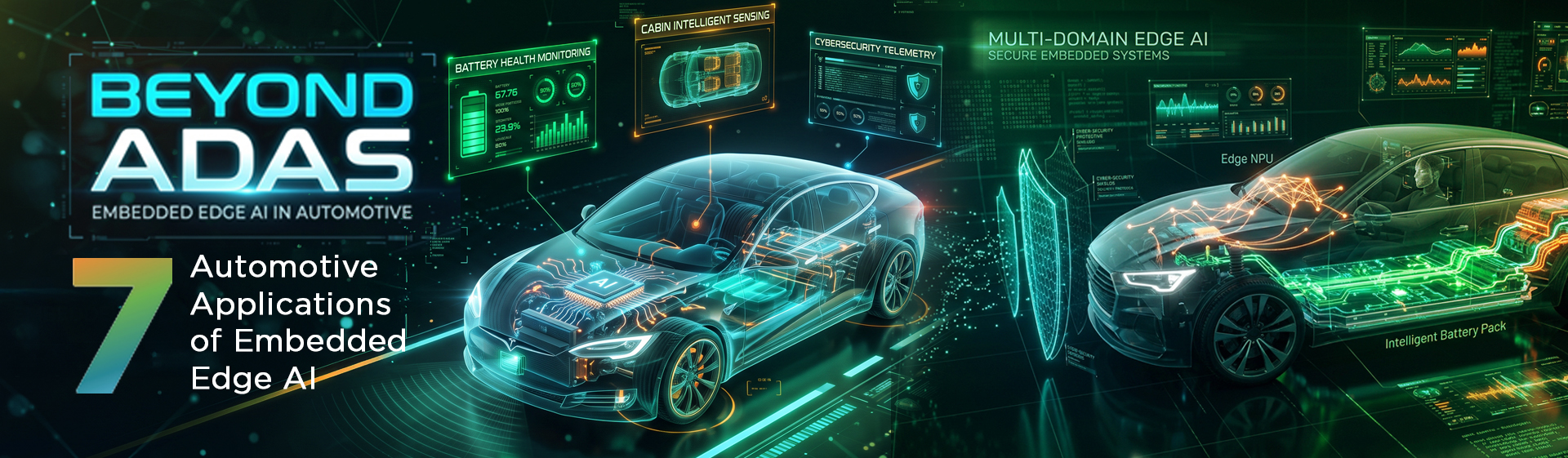
For years, automotive AI was largely associated with ADAS (Advanced Driver Assistance Systems) features such as lane detection, collision warnings, and automated emergency braking. But the role of AI in vehicles is rapidly expanding, supported by advancements in automotive embedded systems.
Today, vehicles generate and process data from cameras, radar, batteries, powertrain sensors, infotainment systems, and connected devices. Sending all this information to the cloud is not always practical when applications require fast response times, privacy, and reliable operation. This is where Embedded Edge AI comes in, enabling AI models to run directly on in-vehicle computing hardware through Automotive Embedded Systems and analyze data close to where it is generated.
This shift coincides with the growth of electric and software-defined vehicles. According to the International Energy Agency (IEA), global electric-car sales exceeded 20 million in 2025, representing one in every four new cars sold worldwide. The IEA expects sales to reach around 23 million in 2026, accounting for approximately 28% of global car sales.
What the Latest Automotive Data Says
| 2025–2026 indicator | Latest figure | Why it matters |
| Global electric-car sales in 2025 | 20+ million | More electrified vehicles require intelligent battery and power-management electronics |
| EV share of global new-car sales in 2025 | 25% | AI is increasingly being integrated into electrified vehicle architectures |
| Expected global EV sales in 2026 | ~23 million | Expands the addressable market for automotive embedded intelligence |
| Expected EV share in 2026 | ~28% | Reinforces the move toward software- and electronics-intensive vehicles |
| In-vehicle AI voice latency | 300–700 ms with edge deployment vs 1,000–2,200 ms for pure cloud, in McKinsey’s analysis | Demonstrates the responsiveness advantage local processing can provide for suitable workloads |
Sources: IEA Global EV Outlook 2026; McKinsey, August 2025.
Why Embedded Automotive Systems Are Moving Beyond ADAS
The automotive electronic architecture is changing from a collection of isolated ECUs toward increasingly connected and centralised computing platforms. In this environment, AI is no longer limited to understanding what is happening outside the vehicle. It can also understand what is happening inside the vehicle and within its electronic and energy systems.
A January 2026 SAE International technical paper specifically identified applications beyond ADAS and autonomous driving, including adaptive energy management, real-time powertrain calibration, predictive diagnostics and personalised user experiences.
The basic difference is straightforward:
| Cloud AI | Embedded Edge AI |
| Data is sent to a remote computing environment | Data is processed within the vehicle |
| Dependent on network availability for cloud processing | Can operate locally |
| Network transmission can introduce latency | Designed for low-latency inference |
| Large amounts of raw data may need transmission | Selected intelligence can be processed locally |
| Privacy depends partly on data-handling architecture | Sensitive processing can remain onboard |
Edge AI does not replace the cloud. A practical automotive architecture can use both: local processing for time-sensitive workloads and cloud infrastructure for fleet analytics, model development, updates and large-scale data processing.
7 Automotive Applications of Embedded Edge AI
1. Driver and Occupant Monitoring
AI-powered cameras can monitor the driver and cabin in real time. Instead of merely capturing video, computer vision models can identify indicators such as driver distraction, fatigue, eye movement, head position, and occupant presence.
This supports Driver Monitoring Systems (DMS), Occupant Monitoring Systems (OMS), and child-presence detection.
For automotive companies, local processing has another advantage: sensitive cabin data can be analyzed inside the vehicle rather than continuously transmitting raw video to the cloud.
2. Predictive Maintenance and Vehicle Diagnostics
A vehicle produces continuous streams of information from temperature, vibration, pressure, current, and other sensors. Embedded Edge AI can analyze these signals and identify patterns that differ from normal operating behavior.
This enables a shift from reactive maintenance to condition-based or predictive maintenance.
For fleet operators and manufacturers, this can help identify potential issues earlier, support maintenance planning, and reduce unnecessary component replacement.
SAE’s 2026 research explicitly identifies predictive diagnostics as a key use case for in-vehicle Edge AI.
3. EV Battery Intelligence
The growth of EVs is creating a much bigger role for intelligent battery electronics. A Battery Management System already monitors parameters such as voltage and temperature; AI can add another layer of analysis to identify patterns across those parameters.
| EV function | How embedded AI can help |
| State of Charge (SoC) | Improve range and energy estimation. |
| State of Health (SoH) | Identify degradation patterns. |
| Thermal monitoring | Detect unusual temperature behavior. |
| Charging | Analyse charging patterns and optimise operation. |
| Cell monitoring | Identify abnormal cell behavior. |
| Energy consumption | Adapt predictions to driving conditions. |
This application is becoming increasingly important as EV adoption scales. The IEA reports that global electric-car sales grew 20% in 2025, exceeding 20 million units.
4. Intelligent In-Cabin Experience
The cockpit is evolving from a conventional infotainment interface into an intelligent computing environment.
Embedded AI can support:
- Natural-language voice interaction
- Gesture recognition
- Personalized climate settings
- Context-aware infotainment
- Driver preference recognition
- Intelligent navigation assistance
The business case is closely linked to responsiveness. McKinsey’s August 2025 analysis found 300–700 ms latency for edge voice-assistance deployments, compared with 1,000–2,200 ms for pure cloud solutions in the tasks it analysed.
Consumer expectations are also moving in this direction. Deloitte’s 2026 Global Automotive Consumer Study surveyed more than 28,500 consumers across 27 markets, while its India findings reported strong interest in software-defined and AI-enabled vehicle features.
5. Vehicle Cybersecurity and Anomaly Detection
As vehicles become connected, cybersecurity becomes part of the embedded-electronics challenge. Modern vehicles can include telematics, Bluetooth, cellular communication, gateways, ECUs and cloud-connected applications.
Edge AI can monitor system behaviour and identify unusual communication or operational patterns that may warrant investigation.
The latest cybersecurity data highlights the scale of the issue.
| Automotive cybersecurity indicator for 2025 | Reported figure |
| Publicly reported incidents analyzed | 494 |
| Incidents involving telematics and cloud | 67% |
| Incidents resulting in data/privacy breaches | 68% |
| Incidents with potential mass-scale impact | 61% |
| Incidents attributed to black-hat actors | 71% |
| Ransom-related incidents | 44% |
Source: Upstream Security, 2026 Global Automotive and Smart Mobility Cybersecurity Report.
6. Intelligent Powertrain and Thermal Management
AI can also help vehicles optimize the systems that consume or generate energy.
Potential applications include regenerative braking, motor-temperature management, HVAC optimization, traction control, and energy consumption prediction.
For EVs and hybrid vehicles, these functions can be particularly valuable because energy efficiency directly affects operating costs, performance, and, in EVs, available driving range.
The January 2026 SAE study identifies adaptive energy management and real-time powertrain calibration among the applications that can benefit from in-vehicle Edge AI.
7. Smart Fleet and Commercial Vehicle Intelligence
The opportunity extends beyond passenger cars. Commercial vehicles can use embedded intelligence for driver-behavior analysis, vehicle-health monitoring, energy optimization, incident detection, and onboard diagnostics.
Processing selected information at the edge can also reduce the amount of raw sensor data that must continuously travel to central systems.
For fleet operators, the objective is simple: turn vehicle data into timely operational decisions.
How Embedded Automotive Systems Enable Edge AI
Behind every Edge AI application is a hardware-software stack. Automotive-grade processors, MCUs, AI accelerators, NPUs, sensors, memory, connectivity, and security components must work together reliably.
The direction of semiconductor development is already visible. In January 2026, NXP introduced its S32N7 processor series for centralized vehicle computing, designed to consolidate vehicle functions and bring AI capabilities into the vehicle core. NXP stated that the architecture can reduce total cost of ownership by up to 20% through greater integration.
| Layer | Role in an Edge AI vehicle |
| Sensors | Collect vehicle, driver and environmental data |
| MCU / CPU | Control and general-purpose processing |
| GPU / NPU / AI accelerator | Execute AI inference efficiently |
| Embedded software | Runs AI models and coordinates system functions |
| Connectivity | Links the vehicle with other systems and the cloud |
| Security hardware/software | Protects data, devices and communication |
This is why embedded automotive systems are becoming strategically important. AI is only as useful as the electronic platform that can execute it reliably.
Where Evolute Group Fits In
The growth of AI-enabled automotive electronics also creates demand for capable electronics manufacturing partners. Evolute Group’s manufacturing arm, Evolute, states that its EMS capabilities include high-end embedded products, SMT, box building, testing, EV batteries and Battery Management Solutions, with automotive among the industries it serves.
Its Vasai facility is described by Evolute as a 30,000 sq. ft. manufacturing facility, with an in-house SMT line with a capacity of 25,000 components per hour, alongside capabilities for complex PCB assemblies, box building, battery packs and testing.
For the automotive industry, capabilities such as these matter because Edge AI ultimately has to move beyond prototypes into reliable, manufacturable electronic products.
The Road Ahead for Embedded Edge AI
The automotive AI story is moving from a single question “Can the vehicle understand its surroundings?” to a much broader one: “How intelligently can the entire vehicle operate?”
The latest industry evidence points toward a vehicle architecture where AI can increasingly support safety, diagnostics, energy, cybersecurity, cabin interaction and fleet operations. At the same time, Deloitte’s 2026 India study reported that 95% of surveyed Indian consumers were willing to pay for software-defined vehicle capabilities, while 84% were willing to adopt AI-enabled customisation. The survey covered 1,501 Indian consumers in October–November 2025.
Key Takeaways
- Embedded Edge AI extends automotive intelligence beyond ADAS.
- Embedded automotive systems are becoming more capable, connected and centralised.
- EV growth is increasing the need for intelligent battery and energy-management electronics.
- Local AI processing can improve responsiveness for suitable vehicle applications.
- Predictive diagnostics can transform raw sensor data into maintenance insights.
- Edge AI can support both intelligent cabin experiences and cybersecurity monitoring.
- Software-defined vehicle architectures are creating new opportunities for onboard AI.
- For OEMs and technology companies, scalable electronics design and manufacturing will be critical to turning Edge AI concepts into production-ready systems.
The future of automotive AI is therefore not simply about adding more driver-assistance features. It is about building vehicles in which intelligence is embedded across the electronic architecture from the sensor and processor to the battery, cabin, powertrain and connected systems.

