
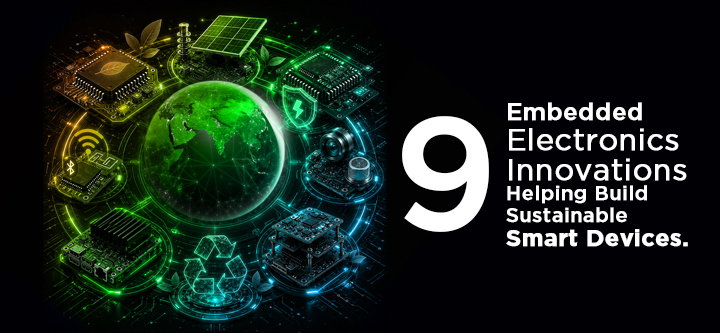
Why Embedded Electronics Is Becoming the Foundation of Sustainable Smart Devices
Sustainability has become a defining factor in modern product development. Whether it is a smart energy meter, industrial automation controller, healthcare wearable, EV charging station, or connected consumer device, businesses are increasingly looking for technologies that reduce energy consumption while improving performance.
This is where Embedded Electronics plays a critical role.
Embedded systems are now enabling devices to process data locally, optimize power usage, predict failures, and extend product lifecycles. According to recent industry estimates, the global embedded systems market is expected to exceed USD 200 billion in 2026, while connected IoT devices worldwide have crossed 21 billion devices, creating unprecedented demand for intelligent and sustainable electronics solutions.
| Key Industry Statistics (2026) | Value |
| Global Embedded Systems Market | USD 200+ Billion |
| Connected IoT Devices | 21+ Billion |
| Global IoT Market Size | USD 900+ Billion |
| Expected IoT Devices by 2030 | 39 Billion |
For OEMs, manufacturers, and technology leaders, the challenge is no longer building connected devices it is building connected devices that are efficient, scalable and environmentally responsible.
How Embedded Electronics Is Driving Sustainable Innovation
1. Edge AI and TinyML Bring Intelligence Closer to the Device
One of the most important developments in embedded technology is the rise of Edge AI and Tiny Machine Learning (TinyML).
Rather than continuously sending information to cloud servers, devices can process data locally using lightweight machine-learning models.
Real-world example:
Smart manufacturing facilities use embedded vision systems to detect production defects in real time without relying on cloud computing.
Benefits include:
- Lower energy consumption
- Reduced network traffic
- Faster response times
- Improved cybersecurity
This makes Edge AI one of the most impactful sustainability innovations in modern electronics.
2. Ultra-Low-Power Embedded Systems Extend Product Lifecycles
Power efficiency remains one of the most important objectives in embedded product design.
Today’s low-power microcontrollers can remain operational for years while consuming only microamps of current in sleep mode.
Example:
Smart utility meters deployed by municipal corporations can function for more than 10 years on a single battery.
Recent engineering research published in 2026 demonstrated embedded architectures capable of reducing dynamic power consumption by up to 98%, significantly extending device lifecycles and reducing battery waste.
3. Energy Harvesting Is Creating Battery-Free Smart Devices
Battery disposal remains one of the biggest sustainability challenges in electronics manufacturing.
Energy harvesting technologies are helping solve this problem.
Modern embedded devices can generate power from:
| Energy Source | Typical Application |
| Solar Energy | Agricultural Sensors |
| Body Heat | Healthcare Wearables |
| Motion | Industrial Sensors |
| RF Signals | Asset Tracking Systems |
| Environmental Energy | Smart Infrastructure |
Example:
Researchers in 2026 demonstrated wearable sensors capable of generating electricity using body heat and movement, reducing dependency on traditional batteries.
4. RISC-V Is Enabling More Sustainable Hardware Design
RISC-V has emerged as one of the most influential open hardware innovations in embedded engineering.
Unlike traditional processor architectures, RISC-V allows manufacturers to create customized processors optimized for specific workloads.
Benefits include:
- Reduced power consumption
- Lower licensing costs
- Longer hardware lifespan
- Greater design flexibility
Several semiconductor manufacturers showcased production-ready RISC-V platforms during Embedded World 2026, highlighting growing industry adoption.
How Embedded Engineering Supports Circular Economy Goals
5. Predictive Maintenance Helps Reduce Electronic Waste
Predictive maintenance is transforming how industrial equipment is managed.
Embedded sensors continuously monitor:
- Temperature
- Pressure
- Vibration
- Current consumption
Example:
Industrial motors equipped with embedded monitoring systems can identify early signs of wear before failure occurs.
This extends equipment life while reducing replacement costs and material waste.
6. Intelligent Power Management Maximizes Energy Efficiency
Smart devices increasingly use adaptive power management systems that dynamically adjust processor performance and communication activity.
Example:
Modern EV charging infrastructure automatically adjusts power delivery based on demand conditions.
This significantly improves overall energy utilization.
7. Secure Over-the-Air Updates Extend Product Lifespans
One of the most overlooked sustainability innovations is secure firmware updating.
Over-the-Air (OTA) updates allow manufacturers to improve products long after deployment.
Benefits include:
- Reduced hardware replacement
- Improved security
- Regulatory compliance
- Extended product lifecycle
This directly supports sustainability objectives by reducing electronic waste generation.
What Will Define the Next Generation of Embedded Technology?
8. AI-Assisted Embedded Engineering
Artificial intelligence is increasingly helping engineers design more efficient embedded systems.
AI-powered development platforms can:
- Optimize software performance
- Identify coding inefficiencies
- Accelerate testing cycles
- Improve power efficiency
For organizations developing next-generation smart products, AI-assisted engineering is rapidly becoming a competitive advantage.
9. Smart Connectivity Technologies Reduce Resource Consumption
Connectivity technologies such as BLE, LoRaWAN, NB-IoT, and Thread are helping organizations build sustainable IoT ecosystems.
| Connectivity Technology | Sustainability Benefit |
| BLE | Ultra-low power operation |
| LoRaWAN | Long battery life |
| NB-IoT | Efficient utility monitoring |
| Thread | Smart building optimization |
| Industrial IoT Protocols | Resource efficiency |
These technologies ensure devices communicate efficiently while minimizing energy consumption.
How Evolute Group Supports Sustainable Embedded Electronics Innovation
As industries accelerate digital transformation, demand for advanced embedded electronics solutions continues to grow. Evolute Group supports enterprises through embedded product engineering, electronics design, intelligent hardware development, industrial automation solutions, and IoT-enabled innovation.
By combining expertise in embedded systems, intelligent electronics, and sustainable engineering practices, Evolute helps organizations develop future-ready products that align with both operational objectives and environmental goals.
Conclusion
The future of sustainable innovation will be shaped by advances in Embedded Electronics. From Edge AI and energy harvesting to predictive maintenance and intelligent connectivity, these technologies are helping organizations build smarter, greener, and more efficient products.
Key Takeaways
- Embedded electronics is driving sustainable smart device development.
- Edge AI reduces energy consumption and improves efficiency.
- Energy harvesting enables battery-free operation.
- Predictive maintenance supports circular economy goals.
- Intelligent power management minimizes energy waste.
- OTA updates extend product lifecycles.
- AI-assisted embedded engineering accelerates innovation.
- Smart connectivity technologies create sustainable IoT ecosystems.
- Evolute Group helps businesses develop next-generation embedded solutions.

