
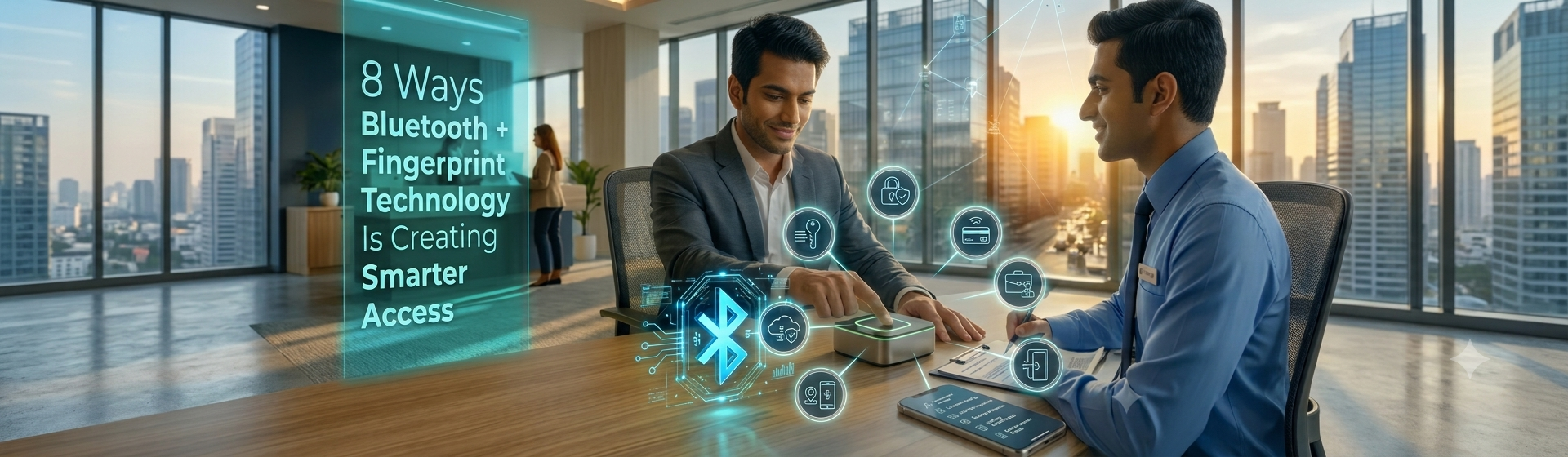
Imagine a banking agent verifying a customer’s identity using a compact fingerprint scanner that connects wirelessly to a mobile device. No complicated wiring. No dependency on a physical card for every interaction. Just connectivity, biometric verification and the right software working together.
This is the direction in which access and authentication are evolving. Bluetooth is becoming a foundational connectivity technology, while fingerprint biometrics are increasingly being incorporated into identity systems.
The Bluetooth SIG’s April 2026 market dashboard now provides ongoing visibility into Bluetooth shipments across consumer, enterprise, and industrial applications. Its 2025 forecast projected more than 5.3 billion Bluetooth-enabled devices in 2025, approaching 8 billion by 2029. Single-mode Bluetooth Low Energy (BLE) shipments are also projected to grow at a 22% CAGR.
But what happens when wireless connectivity and biometric authentication work together?
How Does a Bluetooth Fingerprint Device Work?
A bluetooth fingerprint device combines wireless connectivity with biometric identity verification. Bluetooth or BLE can connect the device to a compatible smartphone, tablet or terminal, while the fingerprint scanner captures and verifies the user’s biometric information.
The basic workflow is:
Connect → Capture → Verify → Authorize → Access
Bluetooth should not be confused with identity verification itself. It provides connectivity or device context, while the fingerprint provides the biometric identity signal. The application then decides whether that authenticated user has permission to access a service or transaction.
Bluetooth + Fingerprint Technology: 2026 Data Snapshot
| Indicator | Latest data | Why it matters |
| Bluetooth device shipments | 5.3B+ projected in 2025 | Shows the scale of Bluetooth-enabled devices |
| Bluetooth shipments by 2029 | Nearly 8B projected | Indicates continued expansion of connected devices |
| Single-mode Bluetooth LE growth | 22% CAGR projected | Highlights growing demand for low-power wireless connectivity |
| Fingerprint biometric use/consideration | 71% of respondents | Shows the continuing relevance of fingerprint authentication |
| Biometrics considered strategic | 45% of respondents | Indicates that biometrics are becoming part of broader identity strategies |
Sources: Bluetooth SIG/ABI Research 2025 forecast and HID 2026 State of Security and Identity Report.
8 Ways Bluetooth + Fingerprint Technology Is Creating Smarter Access
1. Makes Authentication More Convenient
Passwords, PINs and physical credentials can introduce friction, particularly for people who authenticate repeatedly or work outside a fixed location.
A portable Bluetooth-enabled fingerprint scanner can connect with compatible devices while biometric verification adds an identity layer. This can be useful for merchants, banking agents and field employees.
2. Creates Layered Authentication
Modern identity systems can combine multiple authentication factors:
- Something you have: an authorized device
- Something you are: a fingerprint
- Something you know: a PIN or password, where required
This becomes increasingly important as enterprises manage fragmented identity systems.
A June 2026 FIDO Alliance and HID study of 500 IT and cybersecurity decision-makers found that 59% of enterprises manage three or more distinct credential and authentication systems, while 70% had experienced at least one identity-related security incident.
The opportunity, therefore, is not simply faster authentication but better-connected identity management.
3. Strengthens Fintech and Banking Authentication
Fintech is one of the clearest application areas for biometric devices. Micro-ATMs, e-KYC systems, merchant devices and assisted banking terminals require dependable identity verification, often outside traditional branches.
India demonstrates the scale of biometric authentication already taking place.
| India biometric ecosystem | Latest reported figure |
| Live Aadhaar holders | 134 crore |
| Aadhaar authentication transactions | 17,000 crore+ |
| Biometric authentication transactions | 126.2 billion+ |
| Fingerprint authentication transactions | 119.3 billion+ |
Sources: Government of India, March 2026; UIDAI Authentication Dashboard.
These figures do not represent Bluetooth-fingerprint adoption specifically. They demonstrate the enormous scale at which biometric identity verification is already being used in India’s digital ecosystem.
Evolute’s fintech portfolio includes Identi5, a portable Bluetooth biometric fingerprint scanner, alongside Micro-ATM and POS solutions designed for financial-access applications.
4. Makes Field Authentication More Flexible
Authentication does not always happen inside a bank branch or corporate office.
A portable fingerprint scanner with wireless connectivity can support applications such as:
- Last-mile banking
- e-KYC
- Insurance onboarding
- Telecom verification
- Government services
- Field-agent authentication
Bluetooth can help reduce dependence on fixed wired configurations, making compatible biometric solutions easier to deploy in mobile environments.
5. Creates Smarter POS Experiences
The modern POS terminal is evolving beyond payment acceptance. Connectivity, biometric authentication and application capabilities can increasingly exist within a single device ecosystem.
Evolute’s fintech portfolio includes Android POS platforms and biometric solutions, including UniPOS and fingerprint technologies designed for applications such as digital payments and financial access.
This convergence can reduce the need for multiple disconnected devices and create more integrated transaction workflows.
6. Strengthens the Identity Verification Layer
A fingerprint scanner is only one component of a secure biometric system. Sensor quality, matching algorithms, certification and spoof-detection capabilities also matter.
Evolute’s eScan L1 uses an L1-certified FAP20 fingerprint sensor with thermal sensing and AI-assisted fake-finger detection, targeting applications including e-KYC, BFSI, e-governance, telecom and Micro-ATMs.
At the same time, biometric adoption brings greater responsibility around privacy. HID’s February 2026 research found that 67% of respondents had high or moderate ethical/privacy concerns around biometrics, up from 31% the previous year.
Therefore, secure biometric storage, privacy controls and responsible implementation are as important as the sensor itself.
7. Connects Physical and Digital Identity
Smarter access increasingly means connecting physical access with digital identity.
HID’s 2026 research found that 73% of respondents identified identity management as a top strategic priority, while 75% of organizations had deployed or were evaluating unified physical-digital identity solutions.
The emerging model can combine:
Person + Device + Authentication + Permission + Audit
For fintech, this can help create more integrated identity and transaction environments.
8. Creates a Foundation for Context-Aware Access
The next stage of smart access goes beyond asking whether a fingerprint matches.
A system can potentially consider:
Who? → Fingerprint
Which device? → Bluetooth/device identity
Where? → Proximity or location context
When? → Access policy
What can they do? → Authorization
The broader Bluetooth ecosystem is moving in this direction. In May 2026, ABI Research projected that Bluetooth-enabled device shipments could exceed 8.1 billion units annually by 2030, compared with 5.4 billion in 2025, as Bluetooth expands into connected devices, edge AI and IoT applications.
Bluetooth vs Fingerprint: What Does Each Technology Do?
| Capability | Bluetooth | Fingerprint |
| Primary role | Wireless communication | Identity verification |
| Identifies the person? | Not by itself | Biometric matching |
| User interaction | Usually minimal | Finger placement/touch |
| Typical use | Device connectivity/proximity | Authentication/e-KYC |
| Key security focus | Secure pairing and encryption | Template protection and spoof detection |
| Contribution to smart access | Connects devices | Verifies identity |
The combination is therefore more meaningful than treating either technology in isolation.
What Should Businesses Consider?
Before implementing a bluetooth fingerprint device, businesses should evaluate:
- Bluetooth/BLE security and pairing
- Fingerprint sensor certification
- Anti-spoofing capabilities
- Secure biometric data handling
- Device and OS compatibility
- SDK/API integration
- Authentication reliability
- Audit trails
- Scalability
- Privacy and regulatory requirements
The goal should be to build an authentication architecture that is secure, interoperable, and appropriate for the application’s risk level.
The Future of Smarter Access
Bluetooth is providing the connectivity layer. Biometrics are strengthening identity verification. Software is adding authorization and intelligence.
For fintech, this convergence is already relevant to micro-ATMs, biometric POS devices, e-KYC, merchant authentication, and digital identity.
Evolute’s portfolio from Identi5 and eScan L1 to biometric POS platforms and LeoPro’s multimodal authentication capabilities reflects this movement toward connected, multifunctional fintech hardware.
Key Takeaways
- Bluetooth is expanding rapidly across connected-device applications.
- BLE is becoming increasingly important for low-power wireless applications.
- Fingerprint remains a significant biometric authentication modality.
- India’s Aadhaar ecosystem demonstrates the scale of biometric authentication.
- Bluetooth provides connectivity; fingerprint provides biometric identity verification.
- Fintech devices can combine connectivity, authentication, and transaction capabilities.
- Physical and digital identity systems are increasingly converging.
- Security, privacy, and responsible biometric implementation must remain central to smarter access.

