
Digital banking, Aadhaar-enabled services, eKYC, and cashless transactions have made biometric authentication an integral part of modern financial services. As organizations increasingly rely on a Fingerprint Authentication Device to verify user identities, cybercriminals are developing sophisticated spoofing methods using silicone molds, latex casts, gelatin fingerprints, and even 3D-printed replicas. This growing threat has shifted the focus from simple fingerprint matching to intelligent liveness detection.
According to IBM’s Cost of a Data Breach Report 2025, the global average cost of a data breach reached USD 4.4 million, reinforcing the importance of stronger identity verification. The FIDO Alliance’s Enterprise Identity Report (2026) also found that more than one-third of organizations experienced identity-related security incidents despite having digital identity controls in place. These trends highlight why advanced spoof detection has become essential for secure biometric authentication.
Why Every Fingerprint Authentication Device Needs Intelligent Spoof Detection
Traditional biometric systems answered only one question: Does the fingerprint match? Today’s authentication systems must answer another equally important question: Is the fingerprint from a real, living person?
Modern spoof attacks are capable of imitating fingerprint patterns with remarkable accuracy. To combat these threats, biometric devices now combine Artificial Intelligence (AI), Presentation Attack Detection (PAD), thermal sensing, and optical analysis to verify liveness before granting access. This layered approach helps banks, fintech companies, and government agencies reduce fraud while improving customer trust.
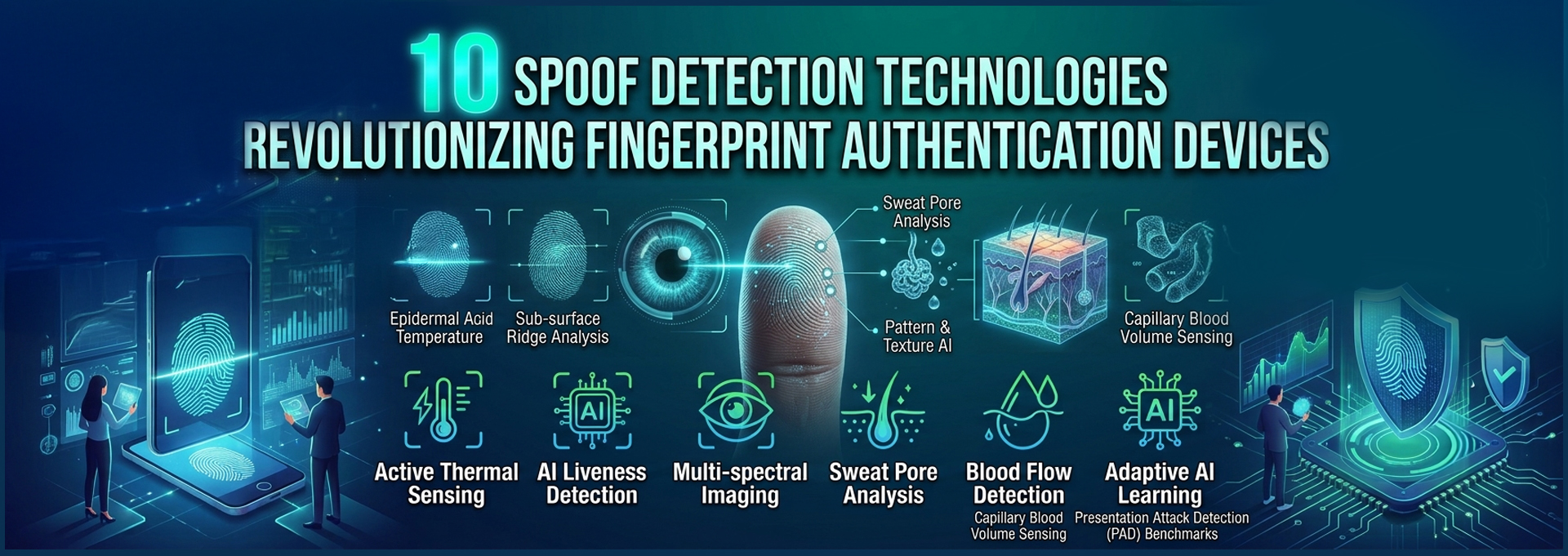
10 Spoof Detection Technologies Transforming Biometric Security
1. Active Thermal Sensing
Living skin naturally emits heat. Active Thermal Sensing measures subtle temperature variations across fingerprint ridges, allowing a Fingerprint Authentication Device to distinguish genuine fingers from artificial replicas made of silicone or plastic.
2. AI-Powered Liveness Detection
Modern AI algorithms analyse ridge patterns, skin elasticity, pore distribution, finger pressure, and texture to determine whether a fingerprint belongs to a live user. Recent research has demonstrated that AI-based Presentation Attack Detection models can achieve over 98% accuracy against common spoof materials under controlled testing conditions.
3. Multi-Spectral Imaging
Unlike conventional sensors that capture only the fingerprint surface, multi-spectral imaging scans beneath the skin to analyse tissue structure and subsurface ridges. Since fake fingerprints cannot replicate these biological characteristics, this technology significantly improves authentication accuracy.
4. Sweat Pore Analysis
Natural perspiration is one of the strongest indicators of a living finger. Advanced biometric systems monitor microscopic sweat pore activity during authentication, making it difficult for static artificial fingerprints to deceive the system.
5. Adaptive AI Learning
Cyber threats evolve continuously. Adaptive AI models learn from newly identified spoof materials and attack patterns, enabling biometric systems to improve detection accuracy without replacing existing hardware.
6. Blood Flow Detection
Premium biometric devices use optical sensors to detect tiny blood circulation changes beneath the skin. Because artificial fingerprints cannot mimic natural blood flow, this provides an additional layer of liveness verification.
7. High-Resolution Ridge Texture Mapping
Modern biometric sensors capture images at resolutions exceeding 500 PPI, allowing detailed analysis of ridge sharpness, edge continuity, skin elasticity, and microscopic surface characteristics. This reduces false acceptance rates while improving spoof detection.
8. Advanced Optical Analysis in a fingerprint scanner
Next-generation optical technologies analyse light reflection, surface texture, and subsurface scattering to identify printed, molded, or synthetic fingerprints. These innovations are expected to become standard in future biometric authentication systems.
9. Multi-Modal Authentication
Many financial institutions now combine fingerprint authentication with facial recognition, device authentication, PIN verification, and behavioural analytics. Even if one authentication factor is compromised, the overall security framework remains protected.
10. Presentation Attack Detection (PAD)
Presentation Attack Detection has become a global benchmark for biometric security. PAD evaluates biological characteristics such as finger movement, skin deformation, optical reflections, and ridge elasticity in real time, making it significantly harder for spoof fingerprints to bypass authentication.
How Evolute Fintech Innovations Is Advancing Secure Biometric Authentication
Evolute Fintech Innovations is enhancing biometric security with advanced solutions designed to combat spoof attacks and strengthen digital identity verification. Its technologies support secure Aadhaar authentication, digital onboarding, eKYC, AEPS transactions, and assisted banking for banks, fintech companies, and government organizations.
The eScan Aadhaar L1 Fingerprint Scanner features Active Thermal Sensing Technology, Adaptive AI, and Fake Fingerprint Detection (FFD) to accurately identify fake fingerprints and prevent biometric fraud. Complementing this, the LeoPro 5G Hyper Terminal delivers secure Aadhaar L1-compliant biometric authentication, enabling faster, safer, and more reliable identity verification across modern financial services.
Industry Snapshot
| Key Industry Insight | Latest Update |
| Global average cost of a data breach (IBM 2025) | USD 4.4 Million |
| Organizations experiencing identity-related security incidents (FIDO Alliance 2026) | More than 33% |
| AI-based spoof detection accuracy in recent studies | Over 98% |
| Projected fingerprint sensor market | Continued double-digit growth driven by banking, fintech, healthcare, and digital identity adoption |
Conclusion
As digital identity becomes central to banking and financial inclusion, biometric authentication must evolve beyond simple fingerprint matching. Intelligent technologies such as Active Thermal Sensing, AI-powered liveness detection, multi-spectral imaging, blood flow analysis, and Presentation Attack Detection are redefining how every Fingerprint Authentication Device protects users against increasingly sophisticated spoof attacks.
Key Takeaways
- Advanced spoof detection is essential for modern biometric security.
- AI and liveness detection significantly improve resistance to fake fingerprints.
- Multi-layer authentication provides stronger protection against identity fraud.
- Evolute Fintech Innovations combines AI, thermal sensing, and Aadhaar L1-compliant technology to deliver secure biometric authentication for fintech applications.
- Investing in intelligent biometric security helps organizations enhance trust, reduce fraud, and deliver safer digital financial services.