
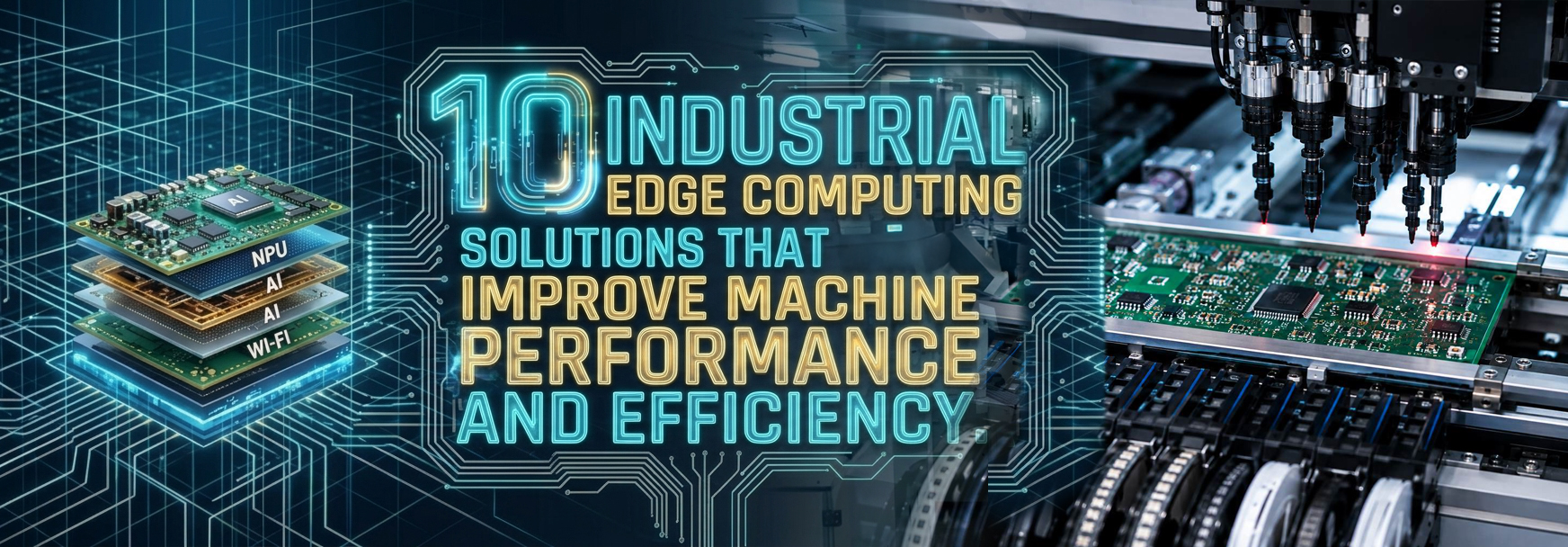
Manufacturers today are under constant pressure to increase production, reduce downtime and improve machine efficiency without proportionally increasing operating costs. As factories become more connected, machines are generating enormous amounts of data from sensors, PLCs, cameras, motors and production systems. The challenge is no longer collecting this data it is processing it quickly enough to make operational decisions.
This is where Industrial Edge Computing is becoming a critical technology for smart manufacturing. By processing data closer to machines rather than sending every data point to a remote cloud, edge infrastructure enables faster analytics, lower latency, improved reliability and real-time machine intelligence.
The shift is gaining momentum. McKinsey’s 2025 Technology Trends Outlook identified edge computing as an increasingly important part of distributed computing, while industrial technology providers are expanding edge-based AI for predictive maintenance, visual inspection and production optimization.
Industrial Edge Computing: The Numbers Behind the Industrial Shift
The business case for intelligent, connected machinery is becoming stronger as manufacturers face increasing downtime and data-management challenges.
| Industrial Indicator | Latest Reported Figure | Business Significance |
| U.S. manufacturers experiencing unplanned downtime | 55% | Shows the scale of machine reliability challenges |
| Weekly potential loss from U.S. manufacturing downtime | Up to $207 million | Demonstrates the financial impact of machine interruptions |
| Global active IoT connections in Q1 2025 | 17.1 billion+ | Indicates the rapidly expanding industrial data ecosystem |
| Enterprise data expected to be processed outside traditional data centres/cloud | 50%+ | Highlights the growing role of edge infrastructure |
| BlueScope avoided unplanned downtime | Nearly 2,000 hours | Demonstrates the potential of AI-driven asset intelligence |
| Evolute Cleantech manufacturing facility | 30,000 sq. ft. | Supports electronics manufacturing and smart production capabilities |
Fluke’s September 2025 research found that 55% of U.S. manufacturers had experienced unplanned downtime, with losses reaching as much as $207 million per week. Meanwhile, Evolute’s May 2025 IoT research cited more than 17.1 billion active IoT connections globally in Q1 2025, demonstrating the scale of connected-device growth.
10 Industrial Edge Computing Solutions for Better Machine Performance
1. Edge AI for Real-Time Machine Monitoring
Edge AI allows machine-learning models to analyze temperature, vibration, pressure, acoustic, and electrical data locally. Instead of waiting for cloud-based processing, the system can identify abnormal conditions and generate immediate alerts.
This is particularly valuable for high-speed production environments where milliseconds can influence machine performance and product quality.
2. Edge-Based Predictive Maintenance
Predictive maintenance uses machine data to determine equipment health and identify early failure patterns. Edge-enabled predictive maintenance can analyse sensor information locally and notify maintenance teams before component failure causes production stoppage.
A 2026 peer-reviewed study in Algorithms specifically investigated edge-enabled predictive maintenance and prognostic health management for industrial systems, reinforcing the growing role of local intelligence in maintenance operations.
3. Industrial IoT Edge Gateways
IIoT gateways connect sensors, PLCs, legacy machines and enterprise platforms. They can translate protocols such as Modbus, OPC UA and MQTT, filter unnecessary data and forward only relevant information to higher-level systems.
This enables manufacturers to modernize existing machinery without replacing entire production assets.
4. Edge Computer Vision for Quality Inspection
AI-powered cameras can inspect components for cracks, scratches, dimensional variations, missing parts and assembly defects directly on the production line.
Local image processing reduces dependency on cloud connectivity and enables faster quality decisions, making edge computer vision especially suitable for high-throughput manufacturing.
5. Digital Twin and Edge Analytics
Digital twins create a virtual representation of machines, equipment, or production lines. When combined with edge analytics, real-time machine data can continuously update the digital model.
Manufacturers can use this information to identify bottlenecks, simulate process changes and optimize machine parameters before implementing them physically.
6. Edge-Based Energy Monitoring
Energy-intensive machines can generate significant operational costs. Edge devices can monitor voltage, current, power consumption, load patterns and machine idle time in real time.
This enables manufacturers to identify abnormal consumption, optimize operating schedules and support energy-efficiency initiatives.
7. Real-Time SCADA and HMI Analytics
Edge-enabled SCADA and HMI systems bring operational analytics closer to the shop floor. Operators can receive immediate alerts, machine diagnostics, and production information without depending entirely on remote cloud infrastructure.
This also improves resilience when external network connectivity is disrupted.
8. Edge Computing for Robotics and Automation
Industrial robots, automated guided vehicles (AGVs) and autonomous production systems require rapid decision-making. Edge computing provides localized processing for machine vision, motion control and sensor fusion.
This helps reduce communication delays and supports more responsive automation workflows.
9. Edge Cybersecurity and Local Anomaly Detection
More connected machines also mean a larger industrial cybersecurity surface. Edge infrastructure can monitor network behaviour and machine activity locally to identify unusual patterns.
Secure boot, encryption, device authentication, network segmentation, and secure firmware updates should therefore be integrated into industrial edge architectures from the design stage. Research published in 2025 also identified cybersecurity and trustworthiness as important considerations for AI-enabled manufacturing systems.
10. Edge-to-Cloud Industrial Data Platforms
Industrial businesses do not have to choose between edge and cloud computing. A hybrid edge-to-cloud architecture can process time-sensitive workloads locally while sending selected historical data to the cloud for advanced analytics, model training and enterprise reporting.
In April 2026, Siemens expanded its Industrial Edge ecosystem with an Industrial AI Suite supporting applications including predictive maintenance and visual inspection across industrial environments.
How Evolute Group Supports the Industrial Technology Ecosystem
For Industrial Edge Computing to work effectively, organizations require dependable electronics, embedded systems, connectivity and manufacturing capabilities.
Evolute Group has built expertise across IoT, embedded systems, electronics manufacturing and intelligent connected devices. Its 2025 work on IoT and embedded technology highlights the convergence of sensors, connectivity, edge computing and AI for industrial applications.
Evolute Cleantech Solutions, the Group’s manufacturing arm, operates a 30,000 sq. ft. manufacturing facility with capabilities including SMT, box-build, testing and electronics manufacturing. Its facility has also been positioned to support industrial, automotive, medical and other technology-intensive sectors.
This combination of hardware engineering, embedded intelligence and manufacturing expertise provides a strong foundation for organizations developing connected industrial products and edge-enabled solutions.
Conclusion: Turning Machine Data into Industrial Intelligence
Industrial Edge Computing is transforming machine data from a passive operational record into a real-time decision-making asset. For manufacturers, its value lies not simply in deploying another technology layer, but in achieving measurable improvements across production.
Key takeaways:
- Faster decisions: Process critical machine data closer to the source.
- Higher uptime: Use predictive analytics to identify potential failures earlier.
- Better quality: Deploy edge AI and computer vision for real-time inspection.
- Lower operating costs: Monitor machine energy consumption and utilization.
- Modernized factories: Connect legacy equipment through IIoT gateways.
- Stronger resilience: Maintain critical processing even during cloud or network disruptions.
- Scalable intelligence: Combine edge processing with cloud analytics for enterprise-wide optimization.
As factories move toward autonomous and AI-enabled operations, Industrial Edge Computing will increasingly become the intelligence layer connecting machines, data, AI and industrial decision-making.