
In an era where digital identity has become the backbone of governance, banking, and financial inclusion, the question is no longer whether biometric authentication should be used but how secure and future-ready that authentication really is.
From Aadhaar-based welfare distribution to instant digital banking and cross-border payments, governments and banks worldwide are facing a sharp rise in identity fraud, spoofing attacks, and biometric replay threats. As a result, 2024 and 2025 have emerged as turning points, with regulators and financial institutions increasingly migrating from legacy biometric systems to L1 fingerprint device authentication.
This shift is not just about compliance it is about trust, resilience, and scalability in a digital-first financial ecosystem.
The Rising Cost of Weak Authentication in Public and Financial Systems
According to a 2024 World Economic Forum (WEF) report, global digital identity fraud losses crossed USD 48 billion, with biometric spoofing contributing to over 23% of high-impact fraud incidents. Banks and government agencies were among the most affected sectors.
In India alone, a 2024 UIDAI audit review highlighted that non-certified or lower-grade biometric devices were significantly more vulnerable to:
- Silicone and gel fingerprint spoofing
- Latent fingerprint replay
- Sensor-level tampering
These findings triggered stricter enforcement of L1 biometric standards across Aadhaar authentication, e-KYC, and Direct Benefit Transfer (DBT) systems.
As a result, secure hardware-based biometric authentication is now being treated as national digital infrastructure, not just a peripheral device choice.
What Makes L1 Fingerprint Scanner the New Gold Standard?
L1 Fingerprint Scanner: Built for Zero-Trust Authentication
Unlike earlier biometric classifications, an L1 Fingerprint Scanner complies with the highest level of biometric security certification mandated by authorities such as UIDAI and global financial regulators.
What sets L1 apart?
- On-device liveness detection (resistant to artificial fingerprints)
- Secure cryptographic modules embedded in hardware
- Tamper-resistant architecture
- End-to-end encrypted biometric data flow
- Zero raw data exposure to host systems
A 2025 NIST-referenced biometric security study found that L1-grade devices reduce biometric spoofing success rates by over 98.6% compared to non-certified scanners.
In simple terms: L1 doesn’t just verify identity it verifies authenticity of the human itself.
Why Governments Are Mandating L1 Biometric Migration
Governments across Asia, Africa, and Latin America are aggressively upgrading biometric infrastructure for welfare, border control, and citizen services.
In March 2024, India’s Ministry of Electronics & IT reinforced that all new Aadhaar authentication deployments must use L1-certified devices, citing:
- National security risks
- Leakage in subsidy delivery
- Rising impersonation fraud
Similarly, a 2025 World Bank Digital ID initiative report noted that countries using L1-grade biometric hardware saw:
- 37% reduction in beneficiary duplication
- 41% faster grievance resolution
- 29% improvement in service delivery accuracy
For governments, the L1 Fingerprint device is now essential for:
- Welfare disbursement (DBT, pensions, food security)
- e-Governance portals
- Border and immigration systems
- National digital ID programs
Why Banks and Fintechs Are Moving Faster Than Regulators
Banks are not waiting for mandates; they are pre-empting risk.
A 2025 PwC Global Banking Survey revealed that:
- 72% of banks plan to replace legacy biometric systems by end-2026
- 64% cited biometric fraud as a top-three operational risk
- 58% linked strong authentication directly to customer retention
For banks, the L1 Fingerprint Scanner enables:
- Secure branchless banking
- AEPS and micro-ATM transactions
- Assisted digital onboarding
- Rural and semi-urban customer trust
In markets like India, Africa, and Southeast Asia, where last-mile banking relies heavily on biometric trust, L1 devices are no longer optional; they are mission-critical.
L1 Fingerprint Device in Fintech Infrastructure: Beyond Compliance
How the L1 Fingerprint Device Enables Scalable Fintech Innovation
Modern fintech is not just digital it is distributed. Micro-ATMs, and mobile terminals operate across urban centers, semi-urban clusters, and deep rural environments. Financial services today must function reliably in low-connectivity zones, high-transaction clusters, and regulatory-sensitive ecosystems.
This is where the Evolute Group plays a pivotal role.
Through its fintech portfolio covering Aadhaar-enabled devices, micro-ATMs, payment terminals, biometric authentication solutions, and digital onboarding systems, Evolute enables institutions to deploy secure, compliant, and scalable financial access points.
When integrated with an L1 Fingerprint device, these solutions deliver:
- Regulatory-ready biometric authentication
- Faster transaction approvals
- Lower false rejection rates (FRR)
- Higher uptime in rural and field conditions
Built for Global Identity Ecosystems – MOSIP Compliance
Beyond domestic deployments, Evolute’s biometric solutions are compliant with MOSIP (Modular Open Source Identity Platform) standards.
MOSIP compliance ensures:
- Seamless integration with national digital ID infrastructures
- Interoperability across government identity systems
- Readiness for global identity and fintech markets
- Secure deployment within public-sector digital ecosystems
This expands Evolute’s footprint beyond traditional fintech use cases into global digital identity programs.
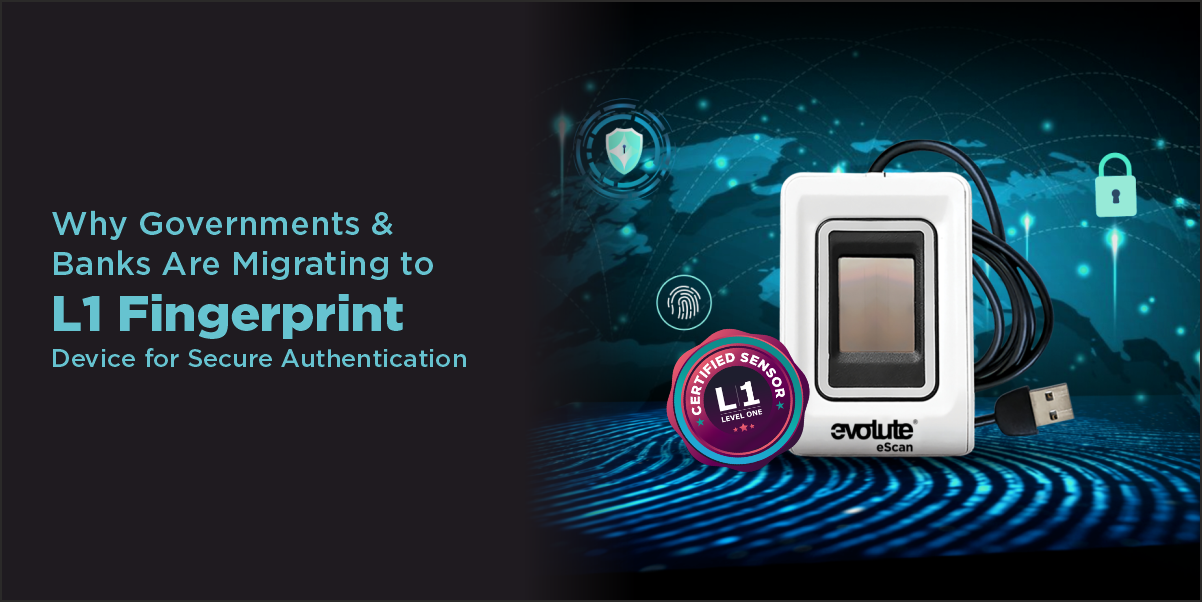
eScan: Evolute’s L1-Certified Fingerprint Device
At the core of Evolute’s biometric portfolio is eScan, an L1-certified fingerprint device engineered for high-performance authentication in distributed financial environments.
Designed for reliability and speed, eScan enables:
- Seamless Aadhaar-enabled transactions
- Secure micro-ATM authentication
- Digital onboarding and eKYC verification
- High-volume rural and semi-urban deployment
Its L1 certification validates secure biometric processing, encrypted communication, and consistent performance across diverse operating conditions making it ideal for scalable fintech networks.
Enabling Secure, Scalable Financial Inclusion
By combining L1-certified biometric hardware like eScan with MOSIP-aligned identity readiness, Evolute enables banks, NBFCs, fintech platforms, and governments to scale financial services securely and compliantly.
In a world where fintech is increasingly distributed, identity assurance is the backbone of trust and Evolute’s certified biometric infrastructure ensures that trust is built into every transaction.
Trust Is the New Currency in Digital Finance
As Satya Nadella once said:
“Trust is the foundation of every digital system. Without it, the scale collapses.”
In 2025, trust is not built through UI or apps, it is built at the authentication layer.
The shift toward L1 Fingerprint Scanner adoption reflects a broader transformation:
- From convenience-first to security-first
- From software-only to hardware-rooted trust
- From reactive compliance to proactive risk mitigation
Governments and banks are realizing that every weak authentication point is a systemic vulnerability.
What the Future Holds: L1 as the Default, Not the Upgrade
By Q4 2025, industry analysts at Gartner estimate that:
- 80% of government biometric deployments
- 65% of emerging-market banking touchpoints
will operate exclusively on L1-certified biometric hardware.
As digital public infrastructure expands CBDCs, digital wallets, embedded finance the L1 Fingerprint device will become the default identity gateway, not a premium option.
Conclusion
The rapid migration to L1 Fingerprint Scanner technology reflects a fundamental shift toward security-first digital ecosystems. For governments, it ensures integrity in citizen services; for banks, it strengthens trust at every transaction touchpoint.
As biometric fraud grows more sophisticated, L1 Fingerprint devices offer hardware-level assurance that software alone cannot match. In the years ahead, L1 authentication will no longer be an upgrade; it will be the baseline for secure digital finance and governance.
Key takeaways:
- L1 Fingerprint Scanner significantly reduces biometric fraud and spoofing risks
- Governments see measurable improvements in welfare delivery and identity integrity
- Banks gain stronger customer trust and operational resilience
- Fintech ecosystems benefit from scalable, compliant authentication
- Evolute Fintech Innovations enables this transition through robust, field-ready fintech solutions

