
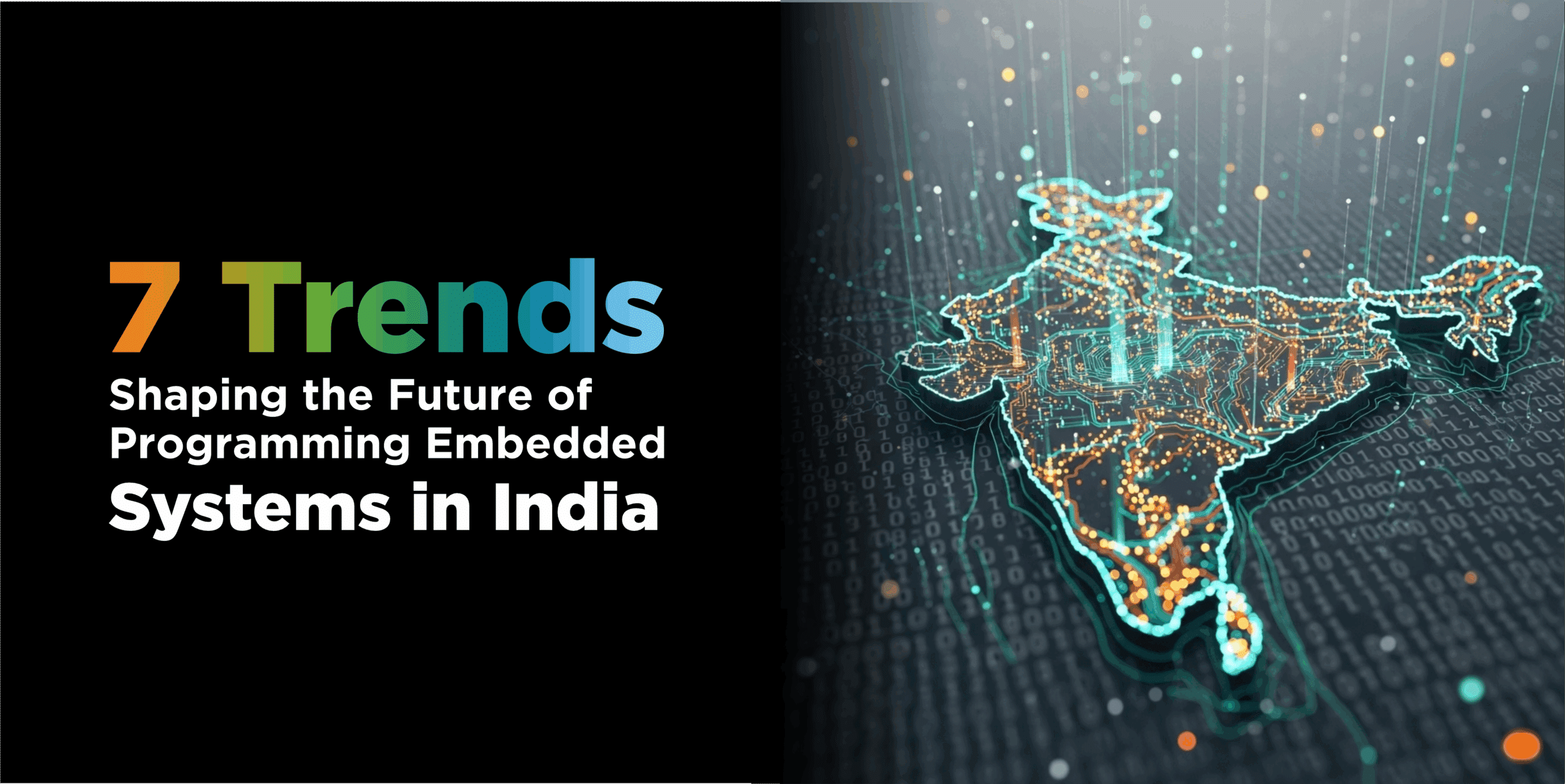
India is becoming a global hub for programming embedded systems, with innovation, government support and deep-tech R&D fueling the transformation. As of 2024, India’s embedded systems market stands at USD 4.47 billion, expected to grow at a 10.3% CAGR, reaching USD 8.05 billion by 2030. A major contributor to this momentum is the booming Edge AI market, which is projected to leap from USD 832.9 million in 2024 to USD 3.65 billion by 2030, growing at 28.3% CAGR.
For pioneers like Evolute’s Glomore Electrotech, this opens vast opportunities to build secure, intelligent and scalable platforms across fintech, mobility and industrial domains. Let’s explore 7 major trends shaping the future of programming embedded systems in India backed by real numbers, current research and aligned with Evolute’s engineering focus.
7 Trends That are Shaping the Future of Programming Embedded Systems
1. Edge AI Leads the Way in Programming Embedded Systems
Edge AI has moved from proof-of-concept to mission-critical. With India’s Edge AI market growing 28.3% annually, embedded systems programming is increasingly incorporating on-device AI inference using frameworks like TensorFlow Lite, Edge Impulse and STMicroelectronics’ STM32Cube.AI.
From biometric sensors in mobile devices to predictive maintenance in industrial systems, embedded developers must now code for AI workloads on microcontrollers, often in real time. Evolute’s modular hardware-software platforms enable seamless integration of these edge intelligence capabilities.
2. Secure by Design: Embedded Code Needs Built-in Protection
In 2025, security isn’t optional. A February 2025 ENISA report revealed that 68% of IoT attacks originate from insecure firmware. That means embedded developers must now code with security as a foundation, not a feature.
Standards like ISO/SAE 21434 and PSA Certified Level 2 are becoming the norm, enforcing practices such as:
- Secure boot and encrypted OTA updates
- Hardware Root of Trust (RoT)
- Static and dynamic firmware analysis
Despite a 15% decline in semiconductor jobs overall, cybersecurity skills in embedded systems remain highly sought after. Evolute’s secure OTA firmware architecture and compliance-ready designs give it a significant edge in this new era of secure-by-design embedded programming.
3. India’s Homegrown Chips: Shakti & RISC‑V Architectures
India is investing in indigenous processor architectures, and it’s paying off. The Shakti SoC developed by IIT Madras has now reached H-Class prototypes, suitable for high-performance and secure embedded applications. In February 2025, ISRO and IIT Madras introduced the IRIS RISC‑V controller for use in space systems.
These open-source architectures provide embedded developers with full-stack control, offering flexibility in system design, debugging and optimization. For companies like Evolute, this trend aligns with the vision of customizable, India-engineered embedded platforms that power industrial and defense-grade solutions.
4. Industry Fuels Smart Manufacturing Demand
Smart factories are now prioritizing embedded automation. According to Rockwell Automation, Indian manufacturers allocate over 35% of their operating budgets to automation and digitization.
The implications for embedded developers include:
- Designing real-time PLC-HMI systems
- Coding for low-latency sensor networks
- Developing RTOS-based industrial controllers
Evolute supports this industrial wave through its rugged relays, sensors and real-time embedded software, making it a partner of choice for manufacturing leaders across sectors like automotive, power and process industries.
5. Electrification and Autonomous Mobility Redefine Automotive Firmware
India’s auto-tech space is undergoing radical change. Embedded software is now the brain behind everything from EV charging infrastructure to advanced driver-assistance systems (ADAS). Qualcomm’s Auto Day (July 2025) showcased advancements in V2X, cloud-connected cockpit platforms and AI vision processors.
For developers programming embedded systems, this means:
- Coding for vehicle-to-everything (V2X) protocols
- Building over-the-air firmware systems for EV components
- Designing safety-critical automotive logic using AUTOSAR frameworks
Evolute’s power electronics and firmware stack for automotive applications is well-positioned to support India’s shift to connected, intelligent vehicles.
6. Quantum & Hybrid Embedded Systems are Emerging
India entered the quantum race with QpiAI’s 25-qubit quantum system, launched in April 2025. As quantum and HPC systems converge, a new programming paradigm is emerging for embedded systems.
Embedded developers must now explore:
- Firmware abstraction for quantum control systems
- Hybrid APIs that bridge classical and quantum processors
- Error-correcting firmware for superconducting environments
With its firmware innovation and abstraction layer development, Evolute is paving the way for next-gen hybrid embedded systems especially in high-performance and secure applications.
7. Skill Renaissance Amid a Talent Crunch
The embedded sector is facing a paradox. While semiconductor hiring dropped 15% in FY 2024-25, niche roles like embedded engineers, RTOS experts and secure firmware developers remain in high demand.
Here’s a breakdown:
- Entry-level embedded programmers earn ₹3–10 LPA
- Senior engineers earn ₹15–20 LPA+
- Government initiatives like Semicon India (₹76,000 crore) and Chips to Startup are fostering curriculum and startup innovation
Evolute contributes to this ecosystem by upskilling engineering talent in secure firmware, RTOS platforms and modular OTA development, ensuring India’s workforce remains ready for tomorrow’s embedded needs.
Expert Insight
“While total GCC hiring dipped, demand for specialists in VLSI, embedded and security‑centric firmware remained strong, buoyed by government initiatives like Semicon India and Chips‑to‑Startup.”- Neelabh Shukla, CBO, Careernet
From Edge AI and secure firmware to RISC‑V SoCs and quantum computing, India is shaping the global narrative in programming embedded systems. Companies like Evolute are not merely adapting to these trends they are architecting the future of intelligent, secure and scalable embedded solutions.
Key Takeaways
- India’s embedded market to reach USD 8.05 B by 2030
- Edge AI growing 28% annually to USD 3.65 B
- 68% of IoT attacks come from insecure firmware
- Homegrown RISC‑V chips like Shakti and IRIS are maturing
- Embedded engineers remain highly in-demand, even in hiring slumps

