Embedded Systems Design – Fueling the Industrial Engine
The year 2025 is a defining moment for industries worldwide, with embedded systems design becoming the invisible architect of progress. From AI at the edge to cyber-resilient IIoT, industries are fast evolving from analog operations to intelligent ecosystems and embedded systems are at the heart of this transformation.
According to a 2025 Global Embedded Market Report by Statista, the embedded systems market is expected to reach $137 billion by 2027, growing at a 6.3% CAGR. This growth is fueled largely by smart factories, energy systems, robotics and secure industrial automation all relying on intelligent hardware-software co-design.
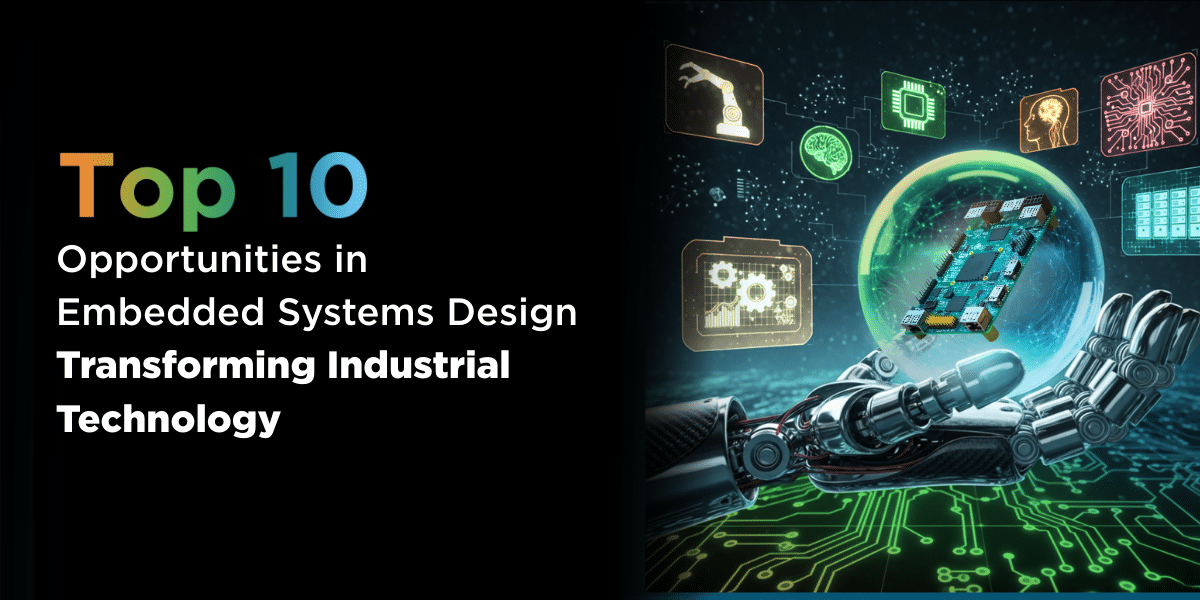
In this blog, we dive into the Top 10 real-world opportunities where embedded systems design is reimagining industrial technology and transforming how industries operate.
10 Opportunities in Embedded Systems Design that are Transforming Industrial Technology in India
1. Edge Intelligence: Reducing Latency, Raising Autonomy
Why It Matters to Industry Leaders
Edge AI, where neural models run directly on microcontrollers and SoCs, is enabling real-time decision-making without round-trip latency to the cloud. According to recent reports, edge-AI deployment in embedded systems rose by 38 % in 2025, significantly boosting processing speed and reducing latency
Industrial Applications
- Predictive maintenance using onboard analytics
- Vision-based inspection on production lines
- Real-time anomaly detection in power grids and robotics
2. Digital Twins: Virtual Mirrors, Real Savings
Modeling Before Manufacturing
Digital twins embedded at the firmware level empower simulation-based validation and anomaly detection. IDC forecasts that 31 % of embedded teams now build virtual replicas to validate firmware before deployment, reducing debug cycles by up to 35 %.
3. RISC‑V Renaissance: Open ISA, Custom Silicon
Strategic ISA Adoption
Open-source RISC‑V adoption surged in 2025 due to its flexible, royalty-free architecture. Embedded systems leveraging RISC‑V saw accelerated customization in industrial SoCs, robotics controllers and vision pipelines.
Business Edge
- Lower per-unit cost
- Tailored instruction sets for power‑sensitive control applications
- Reduced vendor lock-in
4. Time‑Sensitive Networking (TSN): Deterministic Control at Sub-µs Scale
Precision demands in industrial automation
Industrial control networks are increasingly using IEEE 802.1AS-based TSN to ensure deterministic packet delivery with sub-microsecond synchronization. This supports complex robotics, motion control and distributed real-time systems with uncompromised safety and speed.
5. Embedded DevSecOps & Security: From Secure Boot to Live OTA
Embedding Security in the Pipeline
Security is now integral to firmware, with practices like secure boot, hardware root-of-trust and encrypted OTA updates becoming mandatory. Embedded software vendors report 68 % adoption of DevSecOps practices in 2025, involving automated testing and continuous validation.
Risk Assurance
- Reduced firmware-level vulnerabilities
- Compliance readiness for regulations (e.g., EU Cyber Resilience Act)
- Scalable firmware rollbacks and updates
6. Power‑Aware Firmware: Extending Battery & Boosting Sustainability
Energy Metrics That Matter
Power-efficient firmware plus ultra-low-power MCUs reduce operational costs. A 2025 industrial deployment study noted up to 22 % energy savings from optimized firmware power profiling.
Sustainability Gains
- Longer sensor lifetime in IIoT networks
- Less frequent maintenance for remote embedded devices
- Reduced carbon footprint per deployment
7. LPWAN & 5G NR‑Light: Connectivity That Scales
From LoRaWAN to Lightweight 5G
Embedded systems integrating NB‑IoT, LTE‑M, LoRaWAN and the emerging 5G NR-Light (RedCap) enable long-range, low-power connectivity suitable for industrial environments. GSMA forecasted widespread device adoption in 2025, with RedCap modems using just sub-microamp sleep currents.
Industrial Use-Cases
- Utility metering networks
- Logistics and asset tracking
- Smart agriculture and remote asset monitoring
8. RTOS + Embedded Linux: Hybrid OS for Real-Time & Rich Functionality
Combining Hard Real-Time With Connectivity
About 47 % of embedded platforms now run a hybrid architecture: RTOS handles real-time loops, embedded Linux manages UI, security and connectivity. This architecture is prevalent in industrial gateways, HMIs and robotics controllers.
9. Cyber‑Resilience by Design: Hardened IIoT Platforms
Regulation & Reputation Aligned
With new global regulations and rising threats, hardware-enforced security is non-negotiable. The embedded cybersecurity market is projected to grow in triple digits, with investment reaching USD 12 + billion by 2026.
Strategic Value
- Compliance with standards like ISO/SAE 21434 and Cyber Resilience Act
- Trust in mission-critical sectors; manufacturing, energy and defense
10. AI‑Assisted Development: Embedded Engineers as System Architects
Tools That Accelerate Innovation
AI copilots are now driving up to 40 % reductions in development cycles by assisting in code generation, test case creation and simulation
Operational Leverage
- Faster firmware ramp-up
- Reduced human error in device stacks
- Enhanced design predictability
Why Evolute Is the Embedded Systems Partner Experts Trust
Evolute combines proven capabilities in real-time control, secure IoT, industrial robotics firmware and edge-enabled embedded architecture. Our systems integrate low-power MCUs, TSN protocols and DevSecOps pipelines to deliver industrial-grade solutions across smart manufacturing, energy and infrastructure domains.
Conclusion: Embed the Future Today
These 10 opportunities in embedded systems design are not futuristic, they are transformational and actionable now. Industrial leaders who integrate edge AI, digital twins, secure DevSecOps pipelines, LPWAN connectivity and open‑source architectures will unlock serious ROI and resilience.
By leveraging these trends, Evolute is ready to help clients embed smarter, safer and more efficient systems that lead industrial technology into the future.
Key Takeaways:
- Edge AI in embedded systems enables real-time industrial automation without cloud dependency.
- Digital twins integrated at the firmware level reduce validation cycles by up to 35%.
- RISC-V adoption in custom SoCs cuts licensing costs while enabling hardware flexibility.
- TSN protocols deliver deterministic control for precision-critical manufacturing systems.
- Power-optimized firmware design extends IIoT device life and reduces operational costs.
- AI-assisted development tools are accelerating embedded system rollouts by 30–40%.