Introduction: Finance re-imagined
In a world where digital transformation dictates market relevance, financial services are undergoing their own renaissance. In 2025, it’s no longer about where you bank, but how seamlessly financial tools integrate into your daily life. Whether you’re paying for groceries via a retailer’s app, investing through a travel portal, or applying for credit via a ride-hailing service — chances are, you’re already experiencing embedded finance.
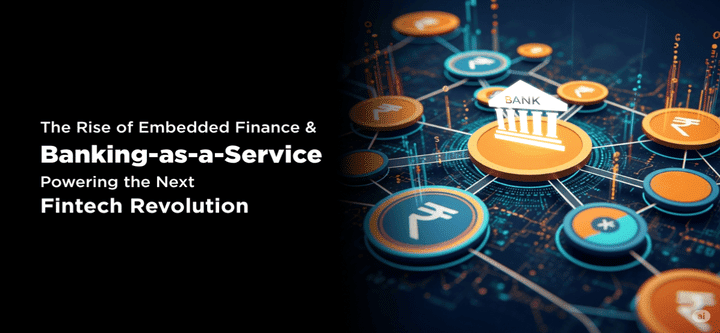
The engine behind this revolution? Two disruptive financial models:
- Embedded Finance: The integration of financial services — payments, lending, insurance and investments — directly into non-financial platforms.
- Banking-as-a-Service (BaaS): A model that enables non-bank businesses to offer regulated financial services using APIs from licensed banks.
Together, these innovations are breaking down the walls of traditional banking, democratizing access and unlocking billions in potential revenue.
Embedded Finance: A Frictionless Future
What Is It?
Imagine buying electronics from your favorite e-commerce platform and being offered an instant credit line, right at checkout — no paperwork, no third-party redirection. That’s embedded finance. It’s about contextual banking — bringing financial services to customers at the point of need, in the most seamless way possible.
By the Numbers
The global embedded finance market is booming. According to MarketsandMarkets, it’s expected to grow from $115.8 billion in 2024 to $251.5 billion by 2029, at a CAGR of 16.8%. Similarly, a 2025 Deloitte report estimates that embedded finance could contribute nearly 10% of global financial transactions by 2030.
In India, the Ministry of Electronics and Information Technology projects that embedded finance could help the country achieve $1 trillion in digital financial services value by 2030, accelerated by platforms like ONDC (Open Network for Digital Commerce).
Real-World Examples
- Samsung (April 2025) launched Samsung Finance+ for its Bespoke AI appliances, offering real-time EMI and credit options at the point of sale — a landmark case of product-driven embedded finance in consumer electronics.
- Uber India has begun piloting driver micro-loans and insurance via its own app, enabled through partnerships with embedded fintech platforms like ZestMoney.
- Amazon now offers credit-building tools, working capital and insurance products to Indian sellers under its new embedded fintech vertical, launched in March 2025.
According to Accenture, platforms that integrate financial services can see an increase of 20-25% in customer retention and 15-30% in lifetime value.
BaaS: Banking Beneath the Surface
What Is It?
Banking-as-a-Service (BaaS) is the infrastructure layer of this transformation. It allows non-banking entities — think fintechs, retailers, logistics companies — to offer banking services by “renting” infrastructure and compliance capabilities from regulated banks.
These services include:
- Digital wallets
- Bank accounts
- Credit and debit card issuance
- KYC/AML compliance
- API-based payments
Growth Snapshot
According to a 2025 report by GlobeNewswire, the global BaaS market is projected to grow from $29.5 billion in 2024 to $74.8 billion by 2030, clocking a CAGR of 16.8%. Nearly 36% of all neobanks globally now operate on BaaS backends.
Key Players
- Walmart x JPMorgan (March 2025): In a major BaaS deployment, Walmart partnered with JPMorgan to launch embedded banking solutions for merchants on its platform, enabling real-time payouts and digital accounts.
- Apple quietly rolled out an embedded credit line in its Apple Pay ecosystem in Q1 2025 via its BaaS partner, Green Dot Bank.
- RazorpayX, India’s leading BaaS provider, now powers over 150 fintech platforms and is expanding into payroll services.
Global Adoption: From Silicon Valley to South Mumbai
North America
The U.S. market is a pioneer. According to Grand View Research (2025), embedded finance transactions in the U.S. are growing at a CAGR of 32%. Major platforms like Shopify, DoorDash and Square are embedding payment processing, lending and insurance directly into their ecosystems.
Europe
Germany, UK and France are leading BaaS adoption in Europe. According to a 2025 Statista report, Germany alone holds 12.3% of the global embedded finance market share, thanks to API-first banks like Solarisbank.
India
India is seeing hyper-growth in embedded finance:
- The embedded lending sector is expected to hit INR 30,000 crore by FY27.
- Platforms like CRED, PhonePe, and Meesho are embedding BNPL (Buy Now, Pay Later) and microcredit into their ecosystems.
- BaaS platforms such as Decentro, M2P and Setu are empowering both fintech and non-fintech enterprises to go live in weeks, not months.
Embedded Finance vs BaaS: What’s the Difference?
| Feature | Embedded Finance | Banking-as-a-Service (BaaS) |
| Focus | End-user experience | Infrastructure enablement |
| Users | E-commerce, mobility, platforms | Fintechs, retailers, startups |
| Services | Lending, payments, insurance | Bank accounts, KYC, APIs |
| End Goal | Seamless, contextual finance | Fast, compliant go-to-market |
| Dependency | Needs BaaS or regulated infra | Needs a partner bank |
They are interdependent: BaaS is the foundation and embedded finance is the facade the end user sees.
Evolute’s Edge: Powering India’s Embedded Finance Backbone
At the heart of India’s embedded finance evolution lies Evolute, a pioneer in delivering next-gen fintech infrastructure and financial inclusion solutions. With decades of experience in powering digital payment ecosystems and smart devices, Evolute is strategically positioned to fuel the rapid adoption of embedded financial services across Bharat.
Solutions That Scale
Evolute’s technology stack enables businesses — from fintech startups to NBFCs and government agencies — to embed:
- KYC and Onboarding modules using biometric and AI-based verification
- Instant Lending & Microfinance infrastructure integrated with core banking APIs
- Smart PoS and Aadhaar-enabled Payment Systems (AEPS) to bridge last-mile financial delivery
- Neo Banking Devices supporting BaaS integrations for rural and urban centers
By building hardware-software synergies, Evolute helps institutions accelerate go-to-market with plug-and-play embedded finance solutions.
Making Finance Inclusive
As embedded finance shapes the digital economy, Evolute is actively empowering:
- Micro-entrepreneurs with accessible credit via embedded micro-loan platforms
- Rural fintech deployments through durable, connected smart devices and AEPS
- Digital literacy via multilingual, touch-based interfaces built for real-world challenges
“At Evolute, we don’t just build devices — we architect financial access. Embedded finance is not only the future of convenience, but also the foundation of inclusion.” – Evolute Leadership Vision
Driving Bharat Forward
Evolute continues to align with national missions like Digital India, Jan Dhan Yojana and UPI 3.0 — not just by riding the embedded finance wave, but by shaping it.
To learn more about Evolute’s embedded finance solutions, visit: https://www.evolute.in
Trends to Watch in 2025 and Beyond
1. Data-Driven Credit
AI/ML is powering credit scoring using alternative data — utility payments, app behavior and even smartphone metadata. Embedded finance platforms are leveraging this to underwrite previously unbanked customers.
2. Regulatory Tightening
With great power comes great regulation. Following high-profile data breaches and compliance lapses in 2024, regulators worldwide — including the RBI, FCA (UK) and OCC (USA) — are imposing stricter guidelines on KYC, data sharing and embedded partnerships.
“Banks are looking to invest for growth. BaaS and embedded finance is an area where they see opportunities to grow and to reach new audiences cost-effectively through indirect channels” Radha Suvarna
3. ESG-Integrated Finance
Green finance is being integrated into embedded platforms. Ride-sharing and food delivery apps are now offering micro-carbon offset credits at checkout, enabled via fintech APIs.
4. AI-Powered Hyper Personalization
Fintech apps are using AI to deliver contextual nudges — like “save ₹200 if you skip one coffee a week” — making banking more interactive and less intimidating.
Why This Matters: Benefits for All Stakeholders
| Stakeholder | Benefit | Details |
| For Consumers | Convenience | Banking where you shop, drive, or stream |
| Speed | Instant credit, real-time KYC | |
| Choice | A range of embedded options tailored to lifestyle | |
| For Businesses | New Revenue Streams | Monetize financial activity |
| Loyalty & Stickiness | Increased app engagement | |
| Data Goldmine | Behavioral and transactional insights | |
| For Banks & Fintechs | Reach | Serve new customer segments |
| Efficiency | Scalable API-based delivery | |
| Innovation | Continuous product experimentation |
Challenges Along the Way
While the future is bright, there are key hurdles:
- Regulatory Ambiguity: Lack of clear compliance frameworks for embedded finance partnerships.
- Security Risks: Increased endpoints mean higher vulnerability to cyber threats.
- Trust Deficit: Consumers may be wary of unfamiliar entities handling their money.
- Tech Integration: Legacy systems often struggle to support API-first delivery models.
The Path Forward: What Should Brands Do?
- Prioritize APIs: Build or partner with robust BaaS providers.
- Invest in UX: Ensure embedded finance flows feel natural, not forced.
- Stay Compliant: Partner with legal and compliance teams early in product design.
- Test, Learn, Scale: Use A/B testing to understand what financial services your users really want.
Conclusion: A Revolution in Real-Time
Embedded finance and Banking-as-a-Service are not just buzzwords — they represent a tectonic shift in how financial services are built, delivered and consumed. In a hyper-connected digital economy, finance must move at the speed of life.
Key Takeaways:
- Embedded finance is expected to reach $251.5 billion by 2029 globally.
- BaaS is growing rapidly with a projected market value of $74.8 billion by 2030.
- AI, personalization and ESG are driving the next phase of growth.
- Regulatory tightening is essential to sustain trust.
- Both embedded finance and BaaS offer massive upside — but demand strategic execution.
As the financial landscape continues to evolve, embracing these innovations will be crucial for businesses aiming to stay competitive and meet the changing needs of consumers.