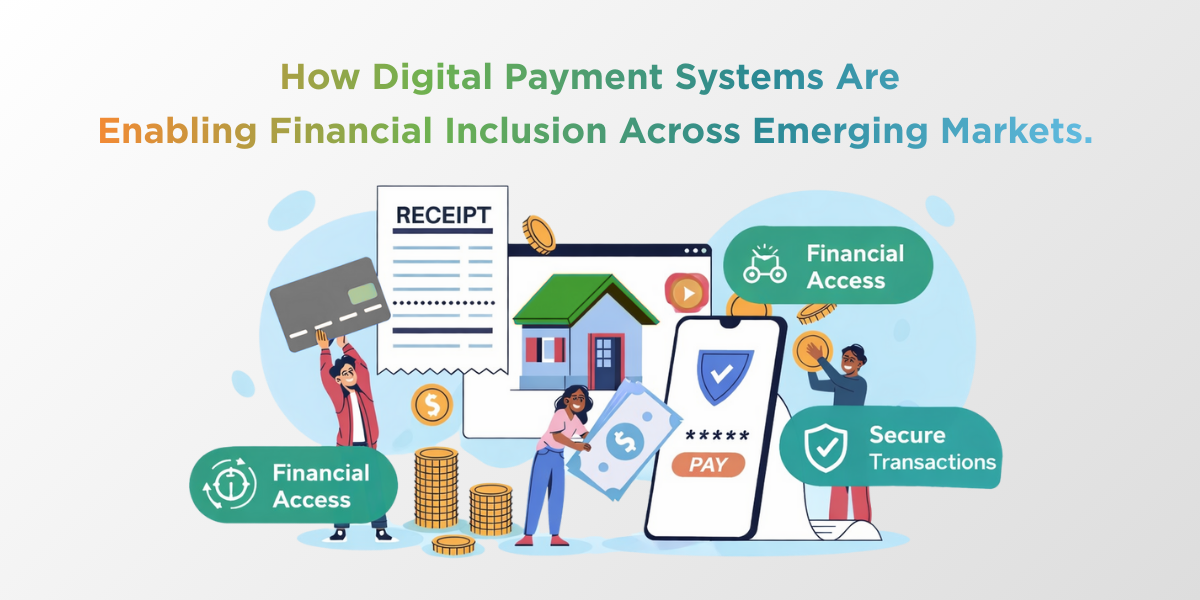
Financial inclusion has long been a structural challenge across emerging markets, constrained by fragmented banking infrastructure, high transaction costs and limited access to formal financial institutions. However, the convergence of technology, regulation and digital public infrastructure has altered this trajectory. Today, digital payment systems are not merely facilitating transactions; they are redefining how economies function, scale and include populations historically excluded from formal finance.
As of early 2025, global policymakers, financial institutions and technology providers increasingly recognize digital payments as a foundational layer for inclusive economic growth. From instant payment rails to interoperable QR ecosystems and mobile-first platforms, digital payment systems are reshaping financial access at an unprecedented pace across Asia, Africa, Latin America and parts of Eastern Europe.
The Financial Inclusion Gap in Emerging Markets
Despite measurable progress, financial exclusion remains a critical concern. According to the World Bank Global Findex 2025, approximately 1.3 billion adults globally remain unbanked, with over 70% concentrated in emerging economies. Structural barriers such as geographic distance from bank branches, high account maintenance costs, informal employment and low credit penetration continue to limit access to traditional banking.
Cash-dominant economies further exacerbate these challenges. In many emerging markets, cash transactions account for over 60% of consumer payments, limiting transparency, credit visibility and economic scalability. This is precisely where digital payment systems have begun to demonstrate transformational impact.
How Digital Payment Systems Drive Financial Inclusion at Scale
Digital Payment Systems as a Financial Access Layer
Digital payment systems act as an entry point into the formal financial ecosystem. By enabling individuals and businesses to store, send, receive and track money digitally, they create verifiable financial footprints often for the first time.
Key inclusion-enabling attributes include:
- Low onboarding costs compared to traditional banking
- Mobile-first accessibility, particularly in low-infrastructure regions
- Real-time settlement, improving liquidity for individuals and SMEs
- Interoperability, reducing dependency on single institutions
In 2024, the Bank for International Settlements (BIS) reported that countries with real-time payment infrastructure saw 30-50% faster growth in financial account adoption compared to those without such systems.
Digital Payment System Adoption Across Emerging Economies
Emerging markets have increasingly leapfrogged legacy banking models by deploying large-scale digital payment infrastructure.
- In Brazil, the central bank-backed instant payment system PIX crossed 170 million registered users by mid-2025, processing transactions equivalent to nearly 40% of the country’s GDP annually.
- India’s digital payments ecosystem, anchored by interoperable real-time rails, processed over 190 billion digital transactions in 2024, with rural and semi-urban users accounting for a growing share.
- Across Sub-Saharan Africa, mobile money platforms now support over $1 trillion in annual transaction value, according to GSMA’s 2025 Mobile Economy report.
These systems reduce dependency on physical bank branches and enable participation in formal finance through basic mobile devices.
Digital Payment System Infrastructure and Public Policy Alignment
A defining characteristic of successful digital payment expansion is strong public-private collaboration. Governments and regulators play a pivotal role by establishing:
- Open, interoperable payment standards
- Consumer protection and data security frameworks
- Regulatory sandboxes to encourage fintech innovation
In February 2025, several emerging economies expanded national digital payment platforms to include government-to-citizen (G2C) and citizen-to-government (C2G) payments, significantly improving welfare disbursement efficiency and reducing leakage.
Enabling MSMEs, Informal Workers and Women Entrepreneurs
Micro, small and medium enterprises (MSMEs) represent over 90% of businesses in emerging markets, yet remain chronically underserved by traditional finance. Digital payment systems directly address this gap.
By accepting digital payments:
- MSMEs gain transaction visibility, enabling access to working capital and credit
- Informal workers transition into traceable income flows
- Women-led enterprises improve financial autonomy and business continuity
A 2024 McKinsey Global Institute study found that MSMEs using digital payments were twice as likely to access formal credit within 18 months compared to cash-only businesses.
Economic Impact and Macroeconomic Benefits
Beyond individual inclusion, digital payment systems generate broader macroeconomic advantages:
- GDP growth: Studies published in late 2024 indicate that economies with high digital payment penetration experience 6-8% incremental GDP growth over five years.
- Tax base expansion: Reduced cash usage improves compliance and transparency.
- Crisis resilience: During economic disruptions, digital payments enable faster relief distribution and liquidity support.
As Bill Gates once noted, “Digital financial services can transform lives the fastest when they are designed for those who need them most.” This principle increasingly underpins policy frameworks across emerging markets.
Addressing the Challenges: Literacy, Security and Trust
Despite momentum, challenges persist. The OECD’s 2025 Digital Finance Outlook highlights that nearly 35% of new digital payment users in developing economies lack sufficient digital financial literacy.
Key risks include:
- Cybersecurity vulnerabilities
- Fraud and identity misuse
- Limited consumer awareness of grievance mechanisms
Leading ecosystems now counter these risks through:
- Biometric authentication
- AI-driven fraud detection
- Targeted financial literacy initiatives embedded within payment platforms
Trust, once established, significantly accelerates adoption and long-term usage.
The Future of Financial Inclusion Through Digital Payments
Looking ahead, digital payment systems are evolving into embedded financial ecosystems, integrating payments with lending, insurance, commerce and public services.
Key trends shaping 2025 and beyond include:
- AI-enabled credit scoring for thin-file customers
- Cross-border real-time payments supporting regional trade
- Programmable payments for subsidies, payroll and supply chains
As emerging markets continue to digitize economic activity, digital payment systems will remain the backbone upon which inclusive growth is built.
Conclusion: Digital Payments as the Foundation of Inclusive Economic Growth
Digital payment systems have moved beyond their role as transaction enablers to become critical infrastructure shaping the future of financial inclusion across emerging markets. By lowering entry barriers, formalising economic participation and creating verifiable financial identities, these systems are unlocking access to savings, credit, insurance and public services at an unprecedented scale.
For governments, enterprises and financial institutions, the focus must now shift from adoption to optimization ensuring interoperability, security, literacy and regulatory coherence. As emerging markets continue to digitize economic activity, digital payment systems will remain the connective tissue between innovation and inclusion, determining how equitably growth is distributed in the years ahead.
Key Takeaways
- Digital payment systems are the primary gateway to financial inclusion in emerging economies.
- Real-time and mobile-first payment infrastructure accelerates formal financial participation.
- MSMEs, informal workers and women entrepreneurs benefit disproportionately from digital payments.
- Strong regulatory frameworks and public-private collaboration are essential for scalable adoption.
- Digital literacy and trust are as critical as technology in driving long-term inclusion.
- The future of inclusive growth depends on how effectively digital payments are embedded into everyday economic life.