
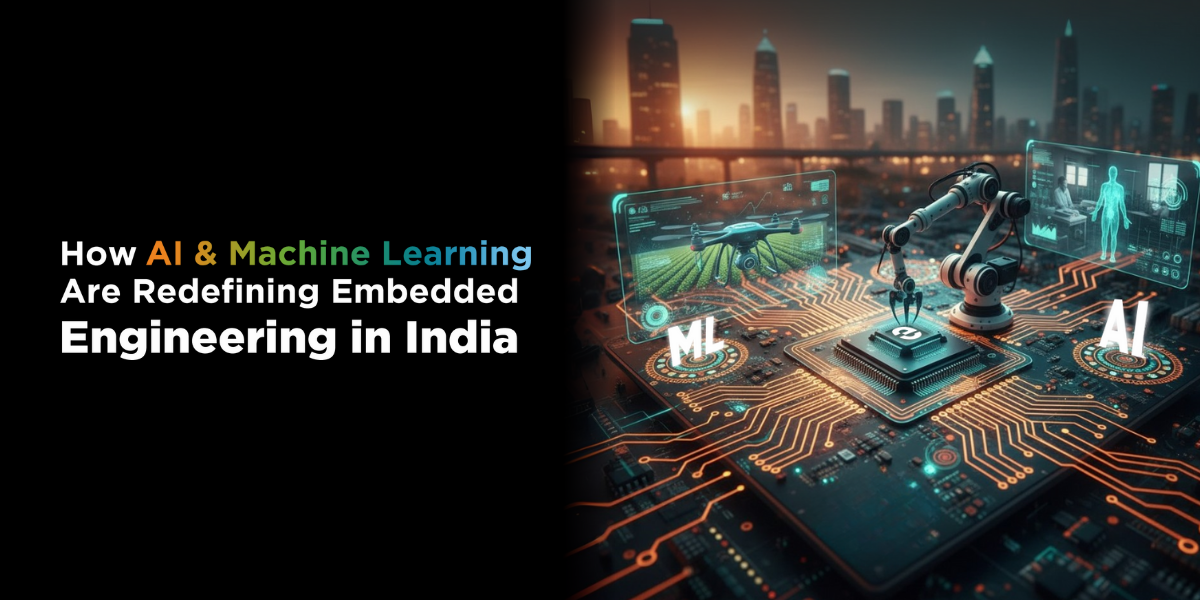
The convergence of Artificial Intelligence (AI), Machine Learning (ML) and embedded engineering is reshaping industries at an unprecedented pace. In India, this transformation is particularly significant, as organizations accelerate digital adoption and demand more intelligent, efficient and adaptive embedded systems. From automotive and industrial IoT to healthcare devices and financial technologies, AI-enabled embedded engineering is no longer a futuristic concept; it is a current business imperative.
A Nasscom-BCG report (February 2024) estimated that India’s AI market could reach USD 17 billion by 2027, growing annually at 25-35%. Coupled with global projections that value the embedded AI market at USD 11.47 billion in 2023 and forecast USD 30.60 billion by 2030 (NextMSC, 2024), the momentum highlights how embedded engineering in India is evolving from conventional fixed-function systems to adaptive, AI-powered solutions.
Embedded Engineering: Moving from Fixed Logic to Adaptive Intelligence
Traditionally, embedded systems were designed to execute specific, rule-based tasks under constrained hardware environments. While effective, such designs lacked adaptability and scalability. The integration of AI and ML changes this equation.
Today, edge AI allows microcontrollers and system-on-chip (SoC) devices to process ML models locally, reducing dependence on cloud computing. According to IoT Analytics (April 2024), edge AI was among the top six global embedded technology trends, driven by demand for real-time decision-making, reduced latency and improved data privacy.
In India, this trend is reinforced by ecosystem developments. Lenovo’s announcement in September 2024 to manufacture AI servers in Puducherry and open an AI-focused R&D lab in Bengaluru demonstrates how infrastructure is being aligned to support embedded AI workloads at scale (Reuters, 2024).
Market Dynamics and Policy Drivers
Expanding Market Opportunities
- Global Growth: Embedded AI projected to grow at a CAGR of 15.1% between 2024-2030.
- Indian Momentum: AI adoption across industries such as BFSI, healthcare and manufacturing is expected to add USD 450-500 billion to India’s GDP by 2025 (Nasscom, 2024).
Policy and Skilling Initiatives
The Government of India has placed AI at the core of its digital transformation agenda:
- IndiaAI Mission (March 2024) – Allocated ₹10,300 crore (~USD 1.3 billion) to build high-quality datasets, AI compute infrastructure and skilling programs.
- AI Training for Entrepreneurs (2025) – Free AI training announced for 5.5 lakh rural entrepreneurs through Common Service Centres (Economic Times, February 2025).
- IIT Delhi Online ML Programme (June 2025) – Certificate program targeting working professionals to bridge AI/ML and embedded system expertise.
These policy-backed initiatives not only create a skilled workforce but also reduce entry barriers for companies embedding AI into hardware and IoT products.
Technology Advancements: Rewriting Embedded Engineering
Model Optimization for Embedded Devices
Techniques such as model pruning, quantization and TinyML are making it feasible to deploy ML models on devices with limited compute and power capacity. A 2025 IJARSCT review highlighted the role of TinyML in enabling speech recognition, object detection and predictive analytics directly on microcontrollers.
Hardware-Software Co-Design
AI-enabled embedded engineering demands closer integration between chip architecture and ML algorithms. Emerging processors are increasingly optimized for matrix operations and inference tasks, while software teams adapt ML frameworks for embedded platforms.
Security and Safety Standards
As embedded AI penetrates critical industries automotive, medical, fintech issues of safety, explainability and compliance become paramount. India’s proposal to establish an AI Safety Institute (2025) underscores the regulatory emphasis on responsible deployment.
Business Challenges: Navigating Complexity
Despite the opportunities, enterprises face several hurdles in embedding AI/ML into engineering systems:
- Resource Constraints – Balancing performance with limited power and memory budgets.
- Latency and Reliability – Ensuring real-time performance in mission-critical applications.
- Data Availability – High-quality localized datasets remain scarce for India-specific use cases.
- Skills Gap – Shortage of professionals proficient in both embedded hardware and ML frameworks.
- Regulatory Compliance – Need for adherence to evolving standards in data privacy, AI ethics and safety.
Evolute’s Strategic Perspective
As an innovation-led technology group, Evolute recognizes that the future of embedded engineering lies in AI-driven intelligence at the edge. By leveraging domain expertise in embedded hardware design, firmware development and system integration, Evolute is uniquely positioned to:
- Develop localized AI-ready embedded solutions for sectors like BFSI, energy and mobility.
- Partner with academic institutions and startups to integrate TinyML and edge inference technologies.
- Create solutions that balance efficiency, affordability and compliance for Indian and global markets.
Evolute’s commitment to innovation aligns with India’s AI roadmap; combining deep engineering capabilities with emerging AI frameworks to deliver products that are adaptive, secure and scalable.
Future Outlook: Embedded AI in India, 2025-26
Looking ahead, embedded engineering in India is expected to evolve in the following ways:
- Mainstream Adoption of TinyML – Power-efficient intelligence across wearables, IoT devices and consumer electronics.
- Federated Learning at the Edge – Privacy-preserving training for healthcare and fintech applications.
- Neuromorphic Hardware Pilots – Initial adoption in industrial automation and robotics.
- Tighter Safety Regulations – Increased focus on explainability and traceability of AI models.
- Localization – AI systems designed for India’s unique linguistic, cultural and environmental contexts.
Conclusion
AI and ML are no longer optional enhancements; they are the new foundation of embedded engineering in India. The transformation is being accelerated by:
- Strong market growth and investment opportunities.
- Government-backed initiatives for infrastructure and skills.
- Research advancements in TinyML, model optimization and edge computing.
- Corporate innovation strategies that integrate AI into embedded product design.
For organizations, the message is clear: those who adopt AI-driven embedded engineering early will define the next decade of industrial competitiveness.
At Evolute, we see this as more than a technology shift; it is a strategic opportunity to embed intelligence into the core of every device and service, enabling India to lead in the global AI economy.