Introduction
The retail sector is rapidly embracing digital transformation, and Android POS machines point-of-sale terminals running on Android are at the forefront of this shift. By integrating artificial intelligence (AI), these devices go beyond simple cash registers to become intelligent hubs that streamline checkout, personalize offers, and boost efficiency. As a TechRadar report notes, Android-based POS systems have surged in popularity: they accounted for an estimated $7 billion market in 2024 and are projected to exceed $71 billion by 2033 (growing at ~29.4% CAGR).
This growth is driven by Android’s low cost, flexibility and huge developer ecosystem giving retailers agile, app-driven terminals that can be customized quickly. In fact, Android devices now form roughly 60% of handheld POS market share as of 2025, thanks to their open-source nature, cloud-integration, and broad hardware compatibility.
Evolute Fintech Innovations has been a key player in this arena. Its portfolio includes Android-based POS terminals and micro-ATMs tailored for digital finance and retail automation. For example, the LeoPOS is a certified Aadhaar L1 Android POS terminal supporting multi-modal biometrics (fingerprint, iris, face etc.), while the Leopard series are fingerprint-equipped Micro-ATM devices. These products underscore Evolute’s focus on secure, Android-powered payment solutions.
As Google CEO Sundar Pichai famously said, “AI is probably the most important thing humanity has ever worked on… more profound than fire or electricity”.
In retail, AI on Android POS machines is exactly that kind of game-changer – enabling smarter checkout experiences and deeper customer insights.
What is an AI-Powered Android POS Machine?
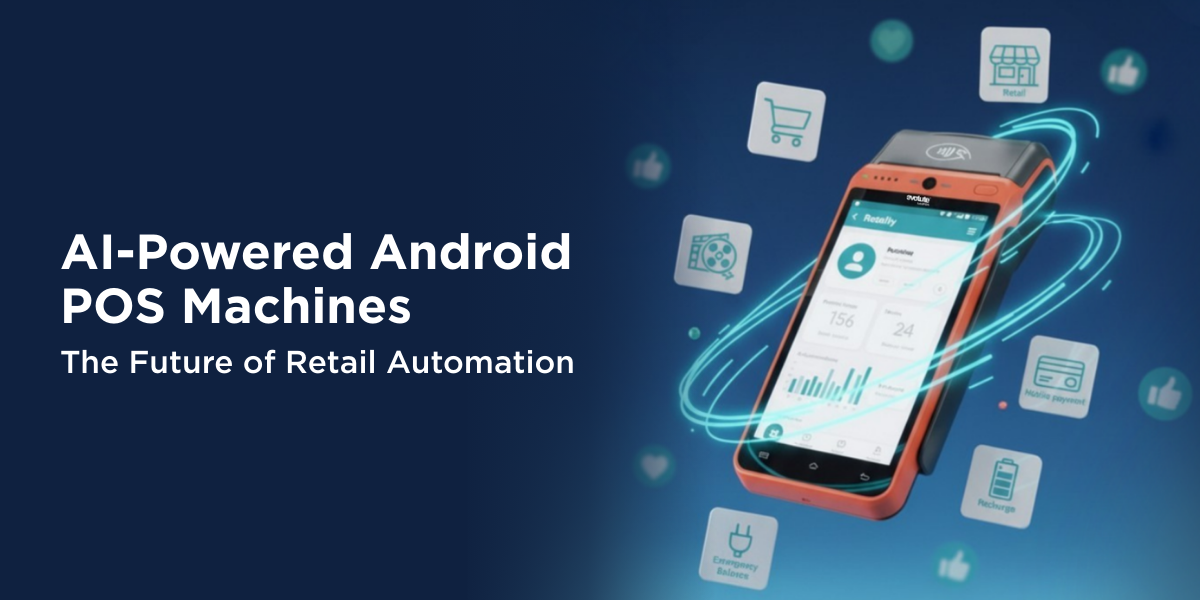
An Android POS machine is essentially a point-of-sale terminal built on the Android operating system. These devices look like tablets or rugged handhelds, often with built-in card readers, barcode scanners, cameras, printers, and fingerprint/iris sensors. The key is that they run Android, allowing stores to install apps just as on smartphones. An AI-powered Android POS goes a step further by using machine learning and data analytics onboard or in the cloud. It can analyze sales data and customer behavior in real-time, enabling features like dynamic pricing, automated fraud detection, and personalized promotions at checkout.
Traditionally, POS systems ran on closed, legacy platforms (often Linux-based) that required specialist development and slow certification. With Android, retailers get a familiar, low-cost OS with a massive developer base and frequent updates. This shift has enabled innovators like Stripe and Revolut to release customizable Android POS terminals in recent years. Android’s flexibility lets stores update the checkout flow quickly – for example, adding a loyalty app or video tutorial – without swapping hardware. And when you add AI, the impact compounds: the device can learn from every transaction to improve pricing or suggest add-on items.
In practice, an AI-powered Android POS might use computer vision to recognize repeat customers, or natural language processing to handle voice commands. It can integrate with cloud-based analytics to forecast inventory needs, or run recommendation engines at the point of sale. For instance, at the register it might suggest cross-sells (like pairing a bottle of wine with a steak) based on a shopper’s purchase history. Meanwhile, its fraud detection algorithms continuously monitor transactions and flag anomalies far faster than manual checks. In this way, the Android POS machine becomes an intelligent retail assistant rather than just a cash drawer.
Core Components and AI Capabilities
AI-powered Android POS machines typically include:
- Biometric sensors (fingerprint/iris) and cameras for secure authentication and identity verification.
- Touchscreen interface running custom Android apps for checkout, inventory lookup, or loyalty programs.
- Connectivity (4G/5G, Wi-Fi) to sync sales data in real time with cloud services and analytics.
- EMV- and PCI-certified payment framework to securely process cards; Evolute’s devices, for example, support EMV L1 certifications and remote key injection for enhanced security.
- On-device AI accelerators (in some models) that let machine learning models run locally, for ultra-low latency.
With these, the AI features can include predictive sales analytics (forecasting demand by linking POS data to inventory systems), dynamic pricing (adjusting prices based on stock levels or time of day), and personalization (tailoring offers to customer profiles). Many retailers are also testing computer vision in POS: for example, cameras that help with self-checkout by identifying items. As one industry report observes, advanced POS now “predict what you might want next” at the register.
Benefits of Android POS Machines for Retailers
The union of Android and AI brings several major advantages for retailers:
- Flexible Hardware and Software: Android-based POS devices are cheaper and more customizable than legacy terminals. Stores can choose rugged tablets, handheld scanners or kiosk modes. Developers can quickly build or download apps (from specialized marketplaces) instead of waiting months for vendor-specific OS certifications. This agility lets businesses keep up with changing needs – for example, adding contactless payment or loyalty features on the fly.
- Enhanced Customer Experience: AI-driven features create a smoother checkout. For instance, one grocery chain piloting AI-POS reported a 15% drop in checkout errors after deploying smart suggestions and real-time price checks. Customers experience faster service (through auto-fill and self-checkout capabilities) and receive personalized deals. Over time, the device can remember preferences and speed up loyalty points, making repeat visits even easier.
- Inventory and Revenue Optimization: Android POS machines can instantly sync sales with inventory software. By applying machine learning, they forecast stock needs so shelves stay stocked without waste. They also enable dynamic upselling and pricing: the system can push relevant add-ons or coupons at the point of sale, boosting average transaction size. Retailers using AI at checkout see measurable gains – not only in sales, but also in reduced waste and better stocking decisions.
- Security and Compliance: Modern Android POS devices support high security standards. They are EMV-certified for chip-card payments, often include encrypted PIN entry, and can incorporate biometric authentication (like Aadhaar fingerprint scanning). Evolute’s Android solutions, for example, are UIDAI-approved for Aadhaar-based transactions. This means retailers can safely offer cash-out/withdrawal services or identity-verified payments. The standardized EMV Contactless specifications (introduced in 2022) further ensure that new Android POS machines remain secure against evolving threats.
- Mobility and Accessibility: Unlike fixed terminals, Android POS devices can be handheld or mounted on carts. This mobility means retailers can break up long lines with roaming checkout, or let staff process payments anywhere on the shop floor. It also opens avenues for field sales and pop-up retailers to take payments on phones or small Android dongles. The pandemic and beyond have shown that flexible POS hardware is key to serving customers in all settings.
In short, AI-powered Android POS machines turn checkout into a strategic tool rather than a bottleneck. They give retailers a “mobile-first” checkout platform that is both customer-friendly and data-rich. As Forbes notes, these systems create dynamic pricing models and personalized experiences by analyzing vast amounts of real-time data. Put simply, an Android POS machine isn’t just for billing – it becomes a business intelligence engine at the point of sale.
Market Trends and Growth of AI-Driven POS
The surge in Android POS adoption is reflected in market forecasts. Industry analysts project explosive growth in POS and retail automation: Fortune Business Insights reports the global AI in the retail market will jump from about $7.14 billion in 2023 to $85.07 billion by 2032 (a 31.8% CAGR). Likewise, the broader POS systems market (including hardware/software) is expected to climb from $29.02 billion in 2023 to $110.22 billion by 2032.
Regionally, emerging markets are driving much of this growth. In India, for instance, handheld POS adoption is booming under government digitization programs. Future Market Insights forecasts India’s handheld POS segment to grow at 12.0% CAGR through 2035, supported by UPI payments and Aadhaar-linked features. Fintech players like Pine Labs, Paytm and Mswipe are flooding the market with affordable Android-based terminals, enabling even small retailers to accept digital payments. Evolute’s own Aadhaar‑enabled Android devices fit squarely into this trend, helping local merchants join the digital economy.
Labor pressures are another key driver. Rising labor costs and staff shortages are pushing retailers to automate mundane tasks; checkout being a prime target. Fortune Business Insights highlights that such challenges are fueling demand for retail automation solutions. Indeed, the global retail automation market (beyond just POS) was valued at $21.19 billion in 2023 and is projected to reach $64.09 billion by 2032 (12.9% CAGR). Point-of-sale systems lead this segment (as noted in Fortune’s report), meaning smarter checkout devices will be a big part of that spending.
In practical terms, retailers are investing in self-checkout kiosks, mobile payment tablets and AI analytics tools. One recent trend is integrating Android POS with computer vision for cashier-less stores (like Amazon Go), or adding voice assistants at checkout. The push for contactless, fast, and intelligent POS is only intensifying. As retail analyst Tom Hay observed, Android has already “displaced Windows-based till systems in many cafes, bars and restaurants” due to its low cost and versatility. The Android POS machine is clearly becoming the new standard platform for retail terminals.
Evolute Fintech Innovations: Pioneering AI POS Solutions
Evolute Fintech Innovations (part of the Evolute Group) has positioned itself as a leader in this evolving market. The company’s focus on fintech hardware and software from Android POS to micro-ATMs directly aligns with the industry trends above. Its corporate profile highlights that Evolute specializes in “POS, Micro ATM, Authentication and remote monitoring solutions” for retail and financial services. In Bangalore and Mumbai, the firm’s full-stack R&D teams design devices and applications spanning Android, Linux, and more. They even have a Mastercard-approved manufacturing facility for mass production.
On the product side, Evolute’s portfolio is tailored for Android-driven retail. Notable offerings include:
- UniPOS A5: A rugged Android POS terminal with built-in fingerprint and iris scanners, a camera and printer. It is Aadhaar L1 certified and accepts cards and digital payments, making it ideal for villages and small shops. (According to Evolute, this is “India’s first certified POS terminal with multiple biometric authentication”.)
- Leopard Micro-ATM: A tablet-like device with a thermal printer and fingerprint module, used in rural banking and payments. It supports AEPS (Aadhaar-enabled Payments) and digital banking services. Evolute also offers a Leopard with a bigger screen and additional biometrics (iris scanner). These leverage Android’s flexibility to run banking apps while meeting security standards (Aadhaar L1, EMV, PCI).
- Impress and Legend Printers: Thermal printers and POS peripherals that integrate with Android terminals for receipts and notifications.
- SoundBox: An audio device that provides voice prompts, useful for users with visual impairments.
- Software Suites: Evolute’s software (e.g. their RD Service App) is UIDAI‑approved for biometric ID on Android, and they offer cloud services (eUMS) to remotely manage and update fleets of devices. They also provide EMV kernel solutions and remote key injection for secure payments.
By combining these products, Evolute enables retailers and banks to deploy AI-ready Android POS ecosystems. For example, an Evolute-powered store might use a UniPOS A5 at checkout, where the device’s AI-driven interface dynamically adjusts prices or highlights loyalty offers. Behind the scenes, a cloud dashboard (built on Evolute’s platform) tracks every sale for analytics. Evolute’s expertise in customizable payment applications also means clients can tailor the Android apps for any retail environment.
In short, Evolute is translating the promise of AI POS into real devices and solutions. Its commitment to innovation, underscored by R&D certifications and industry partnerships means businesses get turnkey Android POS hardware that’s future-proof. As Evolute’s materials emphasize, their approach is “user-oriented” and supports agile, scalable solutions. Retailers looking to automate checkout will find Evolute’s Android POS offerings align with the latest trends: multi-channel acceptance, biometric security, and AI-enhanced intelligence at the point of sale.
Conclusion and Key Takeaways
AI-powered Android POS machines are transforming the checkout experience. By leveraging Android’s open platform and embedding AI capabilities, these devices offer retailers a potent mix of flexibility, intelligence and security. Markets are responding: Android POS is growing faster than almost any other segment, with research projecting double-digit CAGR in the coming decade. In addition, the broader retail automation space is expanding (e.g. $21.2B in 2023 to $64.1B by 2032) as stores adopt smart terminals to reduce labor costs and drive sales.
Evolute Fintech Innovations is at the forefront of this shift. Its Android-based products – from the biometric UniPOS A5 to Leopard micro-ATMs – exemplify the next generation of retail hardware. These solutions support advanced features like Aadhaar-authenticated transactions, EMV payments and remote device management, ready to integrate AI analytics. As tech leaders note, AI is revolutionizing how we live and work, and in retail that begins at the checkout. In the words of Sundar Pichai, AI’s impact is “more profound than fire or electricity”; a reminder that embracing AI-powered POS is not just an upgrade, but a fundamental leap forward.
Summary of Key Points:
- Android POS machines combine Android’s flexibility with smart features. They can run apps, accept multiple payment methods, and integrate biometric sensors for identity checks. Evolute’s UniPOS A5 is an example of such a device.
- AI integration means these POS terminals do more than process sales. They enable dynamic pricing, real-time fraud detection, personalized recommendations and inventory forecasting. A grocery chain using AI-POS saw a 15% drop in checkout errors, illustrating the concrete benefits.
- Market growth is rapid. The Android POS sector was ~$7B in 2024 and could top $71B by 2033. The global AI-in-retail market is also booming (projected ~$85B by 2032, as retailers invest in automation. In India, handheld POS is forecast at ~12% CAGR through 2035, fueled by digital payments.
- Evolute Fintech Innovations’ role: Evolute designs and manufactures Android POS and micro-ATM hardware along with software tools. Its products (e.g. Leopard micro-ATMs, UniPOS A5 Android POS, Impress+ printers) are Aadhaar- and EMV-certified, reflecting the “Aadhaar L1” credentials needed in India. Evolute’s end-to-end solutions help retailers and banks deploy AI-enabled POS networks securely.
- Industry perspective: Experts emphasize that today’s POS is more than cash handling. As one report states, modern POS systems are “intelligent hubs” that streamline operations and personalize shopping. Embracing AI-driven Android POS is cited as a key strategy: Google’s Sundar Pichai even calls AI “something more profound than electricity or fire”, highlighting its transformative potential. Retailers who adopt these technologies now stand to gain competitive advantage and meet the expectations of tomorrow’s shoppers.