
Introduction
In a world rapidly transitioning toward smart devices, connected infrastructure and automated processes, embedded systems are the silent workhorses powering it all. From wearable health trackers and smart meters to industrial robots and autonomous vehicles, embedded systems development is evolving at breakneck speed. As we approach 2026, several technological inflection points are fueling the next wave of innovation making embedded electronics smarter, more efficient and more secure than ever before.
For companies, innovators and product developers, understanding these shifts is no longer optional. This blog explores 10 key trends in embedded systems development that will dominate 2026 shaping how we design, deploy and interact with smart electronics in the coming years.
Why the Surge – Market Context
According to a recent report, the global embedded systems market combining hardware and software was valued around USD 103.3 billion in 2024, climbing to an estimated USD 110.5 billion in 2025. Another forecast sees the broader embedded systems market growing from USD 112.3 billion in 2024 to about USD 169.1 billion by 2030.
This robust growth is being driven by rising demand across sectors: consumer electronics, industrial automation, automotive, healthcare and more. As embedded systems become more ubiquitous, developers face growing expectations of ultra-low power, real-time performance, AI-enabled intelligence, secure connectivity and scalability.
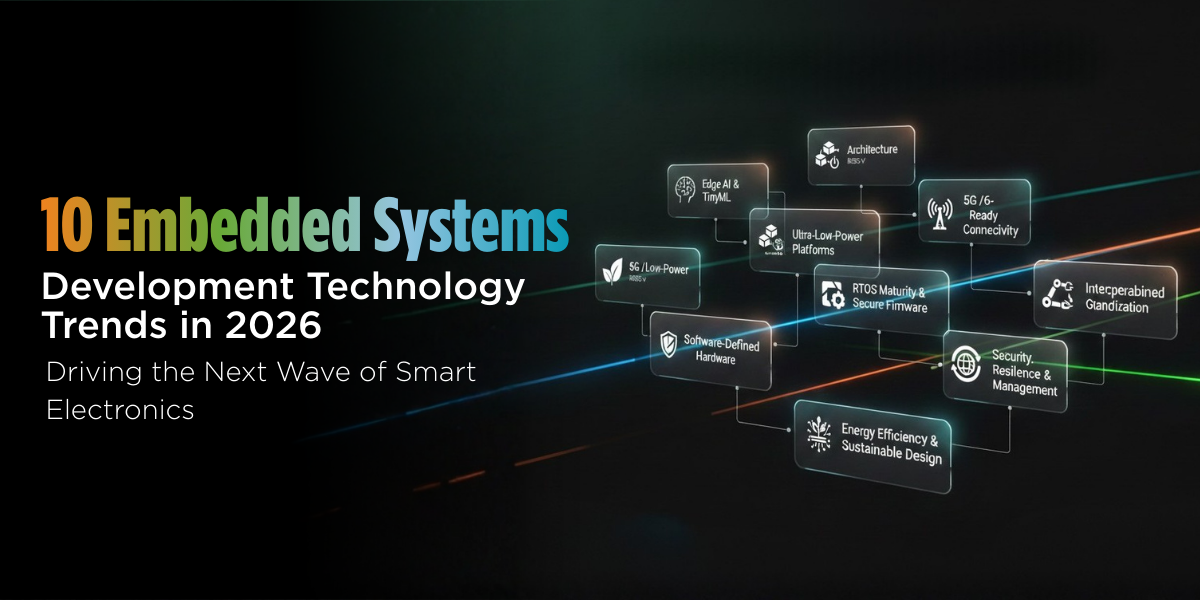
Top 10 Embedded Systems Development Trends to Watch in 2026
1. Edge AI & TinyML: Intelligence on the Device
One of the biggest shifts redefining embedded development is embedding intelligence right on the device, rather than relying on cloud connectivity. 2025-2026 sees the rise of Edge AI and TinyML, where microcontrollers (MCUs) run lightweight machine-learning models locally, enabling real-time decisions, offline operation and reduced latency.
This development matters: embedded devices from smart meters to industrial sensors can now perform predictive maintenance, anomaly detection, voice recognition and other smart functionalities without constant network access. According to industry observers, embedding AI at the edge dramatically reduces latency and enhances responsiveness for mission-critical applications.
2. Open Architecture: Rise of RISC-V and Custom SoCs
Proprietary architectures are giving way to open standards. The open architecture RISC‑V is increasingly becoming a go-to choice for embedded systems developers seeking flexibility, cost-control and hardware sovereignty.
With RISC-V and open ISA ecosystems, developers can build custom SoCs (System on Chips) tailored to specific use cases mixing CPUs, DSPs, NPUs and accelerators without licensing overhead. This shift enables hardware-software co-design and rapid innovation cycles.
Combined with growing support for embedded toolchains and open-source driver ecosystems, this trend lowers barriers for smaller players and accelerates time-to-market.
3. Ultra-Low-Power & Battery-Free Platforms
For many IoT and embedded use cases such as remote sensors, wearable devices or environmental monitors power budget is a critical constraint. In 2026, we expect a wave of ultra-low-power and even battery-free embedded platforms, using energy harvesting (solar, thermal, RF), aggressive power gating, dynamic voltage scaling and context-aware sleep cycles.
Research suggests that such power-optimized firmware design can extend device lifespan by up to 40%. For deployments in remote or inaccessible locations (e.g., agriculture, environmental monitoring, smart infrastructure), this opens up entirely new use cases.
4. 5G / 6G-Ready Connectivity and LPWAN Convergence
With 5G now mature and early discussions around 6G underway, embedded devices are becoming more connected. In 2025, shipments of cellular-IoT modules reportedly rose by 23% year-over-year.
At the same time, low-power wide area network (LPWAN) standards like NB-IoT, LTE-M and LoRaWAN remain relevant for devices needing low bandwidth but long battery life.
For embedded systems developers, this means building firmware and communication stacks that support a hybrid connectivity model, from low-power LPWAN to high-bandwidth 5G/6G depending on the deployment scenario.
5. Real-Time OS (RTOS) Maturity, Safety & Secure Firmware
As devices become more complex and mission-critical (automotive, industrial, medical), deterministic behavior, real-time performance and security become non-negotiable. In 2025, around 70% of embedded developers are reportedly using RTOS frameworks rather than bare-metal or general-purpose OS.
New RTOS variants are offering improved scheduling algorithms (e.g., rate-monotonic, earliest preemptive deadlines), better resource management and significantly higher scheduling efficiency up to 30% more efficient compared to older paradigms.
Security is also front and center: firmware-level protections such as secure boot, hardware root-of-trust, encrypted OTA updates and runtime anomaly detection are moving from optional to standard.
6. Software-Defined Hardware & Heterogeneous SoCs
Embedded systems in 2026 are increasingly powered by heterogeneous SoCs combining traditional CPUs with GPUs, DSPs, NPUs and domain-specific accelerators. This demands software-defined hardware orchestration, where firmware intelligently manages and distributes workloads across different processing units.
Some recent research (2025) demonstrated frameworks that automate firmware-software integration for hybrid systems. According to one such study, automation reduced design time by 25%, making complex SoC-based embedded systems more feasible for a wider range of developers.
This trend powers use cases such as advanced ADAS in automotive, robotics, industrial automation, smart surveillance and more where different processing units handle AI, signal processing, sensor fusion and control logic.
7. Automated Embedded Code Generation – AI-Powered Toolchains
One of the more paradigm-shifting trends is the emergence of automated embedded software development platforms. A recent study published in late 2024 EmbedGenius highlights this shift. The platform uses large language models (LLMs) and domain knowledge to generate firmware for general-purpose embedded IoT systems with 95.7% code accuracy and 86.5% task success rate, outperforming manual approaches by 15-37%.
What this means for embedded development: lower time-to-market, reduced human error and democratization of firmware generation for complex hardware. For Evolute, this presents an opportunity to accelerate prototyping yet still deliver robust, reliable firmware.
8. Interoperability & Standardization – Smart Connectivity Protocols
With billions of IoT and embedded devices expected to be deployed worldwide, interoperability becomes critical. In 2025, industry momentum is building toward universal connectivity standards not just for networks (like 5G or LPWAN), but for device-to-device and device-to-cloud interaction.
This includes standard communication protocols, uniform security practices, API interoperability and open architectures enabling smart devices to work seamlessly across different vendors and platforms.
For embedded systems developers, building with standards in mind ensures long-term compatibility, easier upgrades and better scalability.
9. Emphasis on Energy Efficiency & Sustainable Embedded Design
Sustainability is no longer a buzzword, it’s a mandate. As more devices enter homes, factories, cities and remote environments, energy efficiency and sustainable design are becoming central to embedded development.
Design practices now include: power-optimized firmware, dynamic power management, ambient energy harvesting, use of energy-efficient MCUs/SoCs and longer device lifecycles. These practices allow for maintenance-free deployments over years, a key requirement for industrial IoT, smart infrastructure and remote monitoring systems.
10. Security, Resilience & Lifecycle Management – Embedded Systems as “Safe Systems”
With growing connectivity and complexity, embedded systems are increasingly vulnerable to cyber threats, firmware hijacking and hardware tampering. As a result, security from hardware root-of-trust to encrypted OTA updates, runtime anomaly detection and real-time patching is becoming a first-class design requirement.
Furthermore, with expectations of long-lived deployments, embedded systems now need lifecycle management: secure boot, secure updates, hardware lifecycle support and resilience against environmental stress (power variations, temperature extremes, etc.). This is critical in sectors like automotive, healthcare, industrial automation, energy and smart infrastructure.
Why 2026 is a Pivotal Year
- Mature technologies converging: With open-ISA ecosystems (RISC-V), heterogeneous SoCs and AI-powered toolchains mature enough for real-world deployment 2026 will see a sharp uptick in complex embedded devices.
- Sustainability and power-awareness: Ultra-low power and energy-harvesting designs will unlock use cases in remote monitoring, agriculture, smart infrastructure where replacing batteries is impractical.
- Security and reliability become baseline: With firmware security, secure boot, OTA updates and lifecycle management becoming standard, embedded systems will be viewed less as disposable gadgets and more as long-term infrastructure especially for industrial, automotive and smart-city applications.
- Faster time-to-market through automation: Tools like EmbedGenius using LLMs and automated code generation will significantly reduce development cycles, enabling small teams and startups to build complex embedded solutions quickly and reliably.
What This Means for Industry – And for Companies Like Evolute
For Evolute Group, which focuses on embedded systems development, smart hardware and integrated hardware-software solutions these trends unlock multiple advantages:
- Ability to deliver end-to-end embedded solutions: from hardware design (SoCs, MCUs, sensors) to firmware, connectivity, security and lifecycle management all under one roof.
- Faster delivery and reduced time-to-market: AI-powered code generation, automated toolchains and open architectures make prototyping and productization faster and cost-effective.
- Robust and future-proof products: With security-by-design, energy-efficient designs, connectivity flexibility (5G, LPWAN) and standards compliance devices built today will remain relevant and upgradeable for years.
- Opportunity to tap emerging verticals: industrial automation, smart infrastructure, IoT for rural areas (with sustainable power), autonomous mobility, wearables, medical electronics all driven by embedded systems innovations.
Conclusion
The embedded systems landscape entering 2026 is nothing like what it was a decade ago. With the convergence of Edge AI, open architectures (RISC-V), ultra-low-power design, heterogeneous SoCs, automated firmware toolchains and robust security standards, we are at the cusp of a new era of smart electronics devices that are not only powerful and intelligent, but also sustainable, secure and future-ready.
For developers, product companies and embedded-systems firms (such as Evolute Group), these trends represent tremendous opportunities. To succeed, you must embrace hardware–software co-design, security by default, connectivity flexibility and automation.
Key Takeaways
- The global embedded systems market is rapidly growing from USD 103 B in 2024 to projected USD169 B+ by 2030.
- Edge AI and TinyML are enabling on-device intelligence for real-time, offline, intelligent decision-making.
- Open architectures like RISC-V and custom SoCs are democratizing hardware design, reducing licensing overhead and accelerating innovation.
- Ultra-low-power and energy-harvesting platforms are enabling battery-free or maintenance-free embedded deployments.
- RTOS, secure boot, encrypted OTA, root-of-trust and firmware-level security are becoming baseline expectations.

