
Introduction
In an era where data is the new currency, businesses can no longer treat their point-of-sale (POS) systems as mere transaction counters. The transformation of POS into an intelligent nerve center is underway and AI-driven Android POS machines are leading the charge. These systems don’t just record sales; they mine insights, detect anomalies, predict trends, and drive smarter decisions. In this article, we’ll go beyond billing to explore how Android POS machine systems augmented with AI are redefining business intelligence (BI), and how Evolute’s fintech innovations are well-positioned in this shifting landscape.
Why “Beyond Billing” Matters
Many small and medium enterprises still view POS as a sales register. But in the fast-evolving digital economy, that limited view is a missed opportunity. The integration of AI and analytics means your POS can now:
- Identify purchasing patterns and customer segments
- Suggest dynamic pricing or bundling offers
- Flag fraud or suspicious returns in real time
- Optimize inventory replenishment
- Predict demand surges or dips
According to a 2024 POS Software Trends Study, 85 % of restaurant operators cited “integration with other systems” as a key driver in their 2024 POS purchases. That points to a trend: POS must be part of an ecosystem (CRM, ERP, BI) rather than a standalone tool.
Meanwhile, a market report published in late 2024 noted that AI integration in POS offers functionalities such as dynamic pricing optimization, personalized shopping experiences, and fraud detection. That clearly extends the role of POS far beyond billing.
Android POS Machine as the BI Backbone
Let’s dive into how an Android POS machine can function as your front-line BI engine.
Embedded Intelligence, Real-Time Insights
Modern Android POS devices embed ML models directly or via cloud links. They can monitor sales velocity, detect outliers (e.g. sudden drop in item sales), and issue alerts (e.g. a product that is underperforming this week vs. trend). These real-time insights let managers take corrective action instantly.
Predictive Analytics & Demand Forecasting
By continuously learning from historical sales, seasonality, promotional effects, and external data (e.g. weather, local events), AI models can forecast which items will sell more tomorrow or next week. A 2024 McKinsey survey shows that in companies adopting generative AI, cost decreases and revenue gains have already materialized in functions like supply chain and inventory management.
Personalized Customer Intelligence
Your Android POS can profile customer behavior; for example, frequent buyer segments, response to discounts or cross-sell propensity. Coupled with CRM data, the POS becomes an execution point for targeted offers, loyalty programs or upsell nudges.
Fraud & Anomaly Detection
AI models can flag suspicious returns, transaction spikes or mismatches between expected and actual performance. This adds a layer of security and control that traditional systems rarely offer.
BI Automation & Conversational Insights
Recent research like SiriusBI (2024) demonstrates how Large Language Models (LLMs) can sit atop analytics pipelines, enabling conversational queries (“Why did sales drop in week 42?”) and auto-generation of SQL or dashboards. Meanwhile, AutoBIR (2024) applies generative AI and semantic search to derive BI requirements from casual queries, reducing the friction in building dashboards. In practice, this means your POS system could one day respond like a BI assistant.
Evolute’s Fintech Innovations — on the POS & BI Frontier
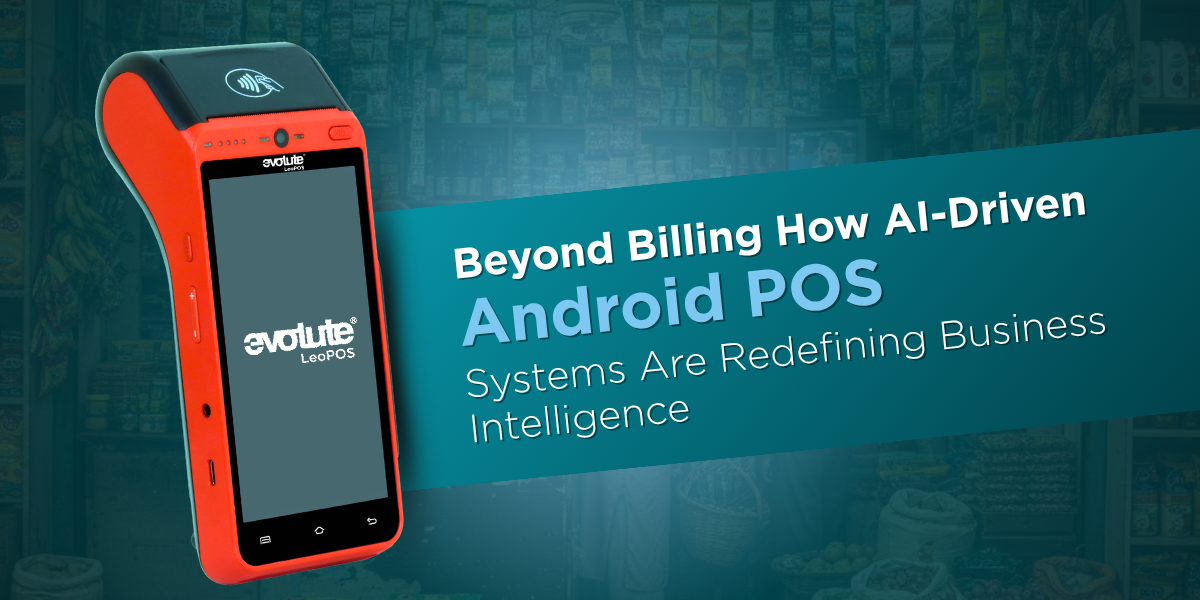
Evolute Fintech Innovations, through its fintech product suite, is already enabling this shift from raw transaction capture to full intelligence-driven operations. Some relevant offerings include:
- Android POS terminals (part of Evolute’s device ecosystem) are not just hardware but integrated with secure biometric, connectivity (WiFi, GPRS, Bluetooth) and edge compute capabilities.
- Omni-channel payment & acquiring solutions enabling unified data flow across online and offline touchpoints.
- Biometric authentication & identity management devices essential for trusted payments and regulatory compliance (e.g. Aadhaar, national ID systems)
- Micro-ATMs and agency banking platforms which, when integrated with POS, help capture financial data in low-infrastructure zones and feed into central analytics.
By bundling intelligent POS terminals with Evolute’s secure connectivity layers and identity solutions, the company positions itself not just as a device vendor, but as a BI enabler for merchants, financial institutions, and microfinance agencies.
Challenges & Ethical Considerations
No transformation is risk-free, and AI-enabled POS systems carry their own challenges.
Data Quality & Integration
Bad data yields bad insights. Ensuring clean, consistent data across POS, inventory, CRM and external feeds is critical. Integration complexity remains a barrier observed by many organizations.
Interpretability & Trust
Users may distrust AI decisions if reasoning is opaque. Ethical AI research in retail points out risks in algorithmic bias or unfair treatment of consumer segments.
Privacy & Regulatory Compliance
Customer data captured at POS (demographics, purchase habits) must be stored and processed in compliance with data laws (GDPR, India’s PDPB, etc.). Transparency, anonymization, and rigorous governance are non-negotiable.
Cost and ROI & Pilot Fatigue
Deploying AI systems (training models, managing servers) has costs. In PwC’s April 2024 Responsible AI Survey, many executives expressed concerns about balancing AI ambition against trust, interpretability, and legal risk.
And broader surveys (McKinsey, 2025 “The State of AI”) show that while 78 % of organizations say they use AI somewhere, many still struggle to scale it to deliver measurable value across functions.
Therefore, pilots and phased rollouts with clear metrics are wiser than “big-bang” deployments.
Rhyming Subheading: “From Insight to Oversight, Be Wise, Be Bright”
It’s not enough to generate insights; organizations must exercise oversight, especially when AI is involved. Establish governance frameworks (audit trails, human review), assign accountable roles (e.g. Chief AI Officer as discussed in recent research, and continuously monitor model drift, bias and compliance.
When your POS suggests inventory shifts or price changes, human judgment shouldn’t be removed, only augmented. That’s how you keep accountability intact while leveraging AI’s speed and scale.
Looking Ahead: The Road to Pervasive Intelligent POS
- Edge Intelligence & Federated Learning: Rather than sending all data to the cloud, models can train locally on Android POS batches and share updates, preserving privacy and reducing latency.
- Conversational BI Agents: Ask your POS: “Which SKUs dipped in August vs July?” and get instant dashboards or narrative answers, thanks to LLM-enabled BI.
- Cross-merchant Benchmarking & Federated BI: Aggregated anonymized intelligence across merchants (e.g. in a region or chain) can yield industry benchmarks.
- Autonomous Optimization: The POS system might autonomously adjust prices, promotions or reordering in real time within guardrails set by you.
- Integration with IoT & Sensors: Combine POS data with sensor inputs (footfall counters, environmental sensors) to enrich predictive models further.
Given that India’s AI market is projected to reach USD 17 billion by 2027, growing ~25–35 % annually from 2024 onward, the tailwinds are strong for intelligent POS adoption.
Conclusion
In the next generation of commerce, billing is just the baseline. AI-driven Android POS machines are evolving into full-fledged business intelligence hubs capturing, analyzing, predicting, and prescribing. For enterprises willing to embrace this shift, the payoff is not just smarter operations, but competitive differentiation.
Evolute Fintech Innovations sits at the crossroads of this evolution, providing devices, identity infrastructure, and payment platforms that can make this leap real for merchants and financial partners alike.
To succeed, businesses must focus not just on intelligence, but on governance, ethical design, and phased adoption. When done right, the transformation is profound: your POS stops being passive and becomes a proactive asset guiding decisions, streamlining workflows, and amplifying ROI.
Key Takeaways:
- AI-powered Android POS systems are transforming from mere billing tools into real-time business intelligence engines.
- Predictive analytics in POS enables data-driven decision-making, improving sales, inventory, and customer engagement.
- Evolute Fintech Innovations leads this shift with AI-ready Android POS devices and integrated fintech ecosystems.
- Real-time insights from POS transactions are turning data into strategic business capital.
- Governance, transparency, and AI ethics remain crucial for building trust in financial intelligence systems.
- The future of POS lies in edge intelligence and conversational BI, driving smarter, inclusive, and connected commerce.

