Introduction
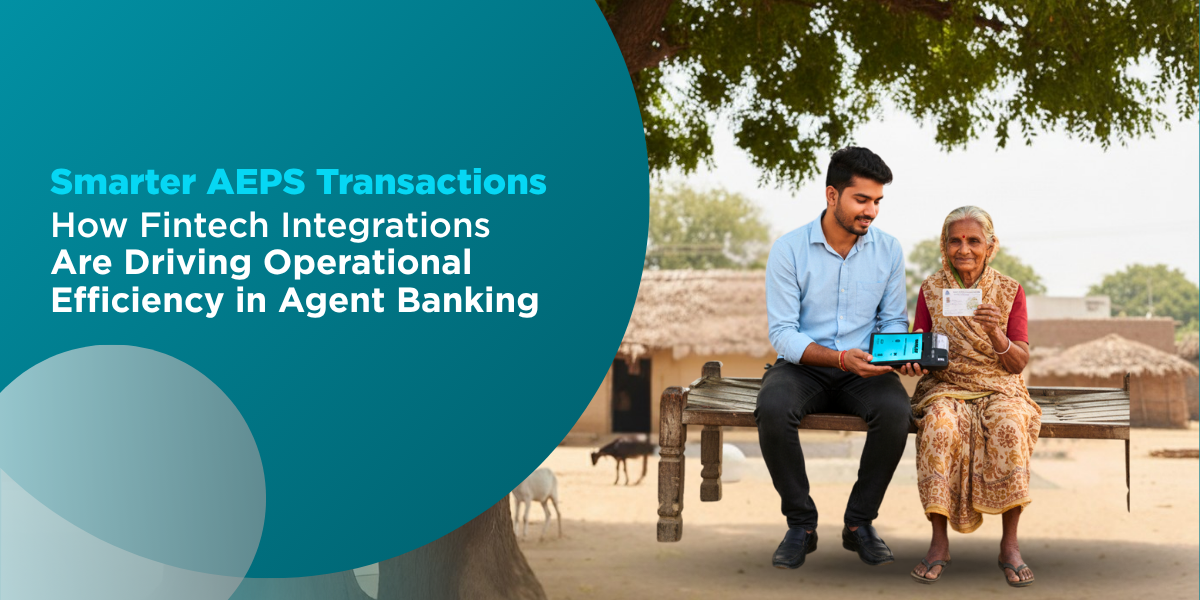
In a country as diverse and populous as India, banking beyond branch walls is no longer optional it’s essential. Aadhaar‐Enabled Payment System (AEPS) transactions have become a cornerstone of agent banking, bringing financial services into remote areas where banks are sparse. But sheer reach is not enough: speed, security, cost, reliability matter. In 2024, we’re seeing how fintech integrations are transforming AEPS transactions not just in volume, but in operational efficiency, agent satisfaction and customer trust.
Why AEPS Transaction Efficiency Matters
- Scale & Inclusion: India witnessed over 2.4 billion AEPS transactions in FY 2024, a number that underscores deep rural penetration.
- Regulatory & Cost Pressures: Agents deal with biometric failures, network issues, reconciliation work, reconciliation delays all eat into margins. Delays frustrate end‐users who expect instant, reliable access.
- Trust & Security: AEPS relies on Aadhaar authentication, biometric devices; fraud risk and identity‐verification issues remain key challenges. Any inefficiency weakens user trust, which is hard to rebuild.
How Fintech Integrations Boost Efficiency – Rhymes & Reasons
Below, we explore concrete mechanisms by which fintech integrations are making AEPS smarter and leaner.
1. Hardware + Software: Smarter Devices, Faster Checks
Agent banking heavily depends on devices: micro-ATMs, biometric scanners, POS terminals. Evolute’s product suite includes Android POS, microATMs, biometric authentication devices and omni-channel payment solutions. These devices, when integrated with reliable AEPS software, reduce latency in authentication, reduce device failures and allow for multi-bank support.
2. Centralised KYC & Regulatory Integration
Recent changes (in 2024) to regulatory frameworks, the amendment of KYC directions aligning with Prevention of Money Laundering rules encourage fintechs and banks to integrate with central KYC registries, KYC Records Registry (C-KYCR), simplifying onboarding and reducing friction. Agent banking benefits: once a customer is verified centrally, fewer repeated checks, fewer rejection errors, faster transaction initiation.
3. Network & Connectivity Enhancements
In many rural / semi-urban areas, connectivity is intermittent. Fintech integrations enable caching and retry logic in AEPS terminals (e.g. buffer biometric data, queue transactions, auto-sync). Also, multiple network providers, fallback channels, offline modes where possible. These software enhancements lead to much better uptime and fewer failed transactions.
4. Fraud Prevention & Real-Time Monitoring
Machine learning (ML), biometric liveness detection, device authentication are now being embedded in AEPS workflows. For example, Evolute’s devices include biometric authentication and secure firmware to reduce tampering. Real-time dashboards track agent performance and transaction anomalies. Fraud prevention becomes not after the fact, but part of the transaction life cycle. Research from 2024 shows financial institutions integrating AI/ML for fraud detection and operational control see up to 30-40% reduction in transaction losses in pilot studies.
5. Seamless Reconciliation & Agent Settlement
Agents often complain of delays in settlement, reconciliation mismatches, or paperwork. Fintech systems integrated with backend banking systems, micro-ledgers, automated settlement and digital audit trails mean reconciliations can be instantaneous or near-instant. Agents get paid on time, errors are fewer, trust is preserved.
AEPS Transaction Efficiency in Action: The Stats & Studies
To ground this in recent data:
- In 2024, per the India Payments Handbook 2024-29 (PwC), digital payments in India saw 42% year-on-year growth in transaction volume in FY 2023-24.
- UPI transaction volume grew by 57% YoY in the same period; the total retail digital payments volume in India crossed INR 199.9 trillion.
- Grant Thornton’s India Payments Trends Report 2024 highlights that fintech integrations with centralised KYC systems and regulatory tools reduce fraud risk and enable faster onboarding.
- According to academic work on AI/ML in finance (2024), institutions integrating ML in payments/fraud operations see operational cost reductions (staff, error, exception handling) of 25-35% over a year.
These numbers point to big gains when AEPS is embedded in a well-integrated fintech stack.
Evolute’s Products: Tools that Tune Efficiency
Evolute Fintech Innovations is not just observing these shifts it is powering many of them through its product line. Key fintech products from Evolute Fintech Innovations (as listed on their site) include:
- microATMs – enabling AEPS agents to offer banking services in remote locations with portable, rugged hardware.
- Android POS terminals – which allow multiple payment types, biometric integration, connectivity options.
- Omni-channel payment solutions – allowing a mix of offline/online, QR, biometric, NFC etc.
- Biometric authentication devices – hardware + software to capture and validate fingerprints/iris etc, with anti-spoofing/liveness checks.
These offerings, when properly integrated with backend banking systems, biometric databases, central compliance & KYC tools, make transactions smarter: faster authentication; fewer failures; better reporting; real-time status & monitoring; efficient settlement. All contribute to better operational metrics for agents and better customer satisfaction.
Overcoming Challenges: Bright Lights, Tough Bites
Of course, efficiency gains don’t come without hurdles. Some of the current obstacles:
- Device reliability & maintenance in remote areas: heat, dust, power fluctuations degrade hardware. Need robust build + remote firmware updates.
- Connectivity & power issues: sometimes just no network or intermittent power makes AEPS fail, unless offline or retry modes are in place.
- Digital literacy & trust among agents/customers: even with good tech, if the agent doesn’t trust biometric or the customer fears data misuse, adoption is compromised.
- Regulatory compliance overhead: privacy laws, data protection, Aadhaar regulations require strict controls. Non-compliance leads to reputational or legal risk.
However, many fintech integrations are directly targeting these challenges for example, hardware engineered for rugged conditions; training modules for agents; robust security & data-privacy by design; regulatory frameworks being clarified in 2024.
Looking Ahead: Smarter, Swifter, Safer AEPS
What trends and innovations are shaping the next frontier?
- AI/ML-driven predictive error correction: anticipating biometric failures, recommending alternate banks/devices, reducing error rate before failure.
- Edge computing in devices: doing authentication pre-processing locally (device side) to reduce latency / dependence on the network.
- Phygital expansion: combining physical agent networks with digital dashboards, remote monitoring, chatbots, etc. This hybrid model ensures both reach and efficiency.
- Regtech & compliance embedded: GDPR-like norms, Aadhaar confidentiality, device security certification will become standard, raising the bar for all devices & software.
Conclusion
Smarter AEPS transactions are not just about pushing more transactions through; they are about making every transaction more efficient, secure authentication, faster processing, lower failure rates, swift agent settlement and stronger customer trust. Fintech integrations, be it via Evolute’s hardware & software suite, AI/ML tools, or regulatory/compliance infrastructure are central to that transformation.
As Evolute Fintech Innovations continues to roll out rugged microATMs Android POS devices, omni-channel solutions and biometric authentication tools, the goal is clear: empower agent banking with tools that sharpen performance, reduce friction and build inclusive trust. In FY 2024 and beyond, those who integrate smartly will lead in agent banking not just by being everywhere, but by doing AEPS everywhere well.